Guides
MOTS-c: structure, analytics and handling in research
MOTS-c is an unmodified, linear peptide of 16 amino acids whose sequence is encoded in the mitochondrial genome. This guide explains its structure, how it differs from related molecules, how to check certificates of analysis, and the storage and handling of the lyophilisate.
Research Use Only- Published2026-09-24
- Updated2026-09-24
- AuthorGPeptides editorial team (operator)
Overview and naming
The abbreviation MOTS-c is a statement of location: it refers to a short open reading frame in the 12S rRNA gene and thus to the genome of the mitochondria, not to a function. MOTS-c is also the name customarily used in the literature. In databases and catalogues, the spellings MOTSc, Mots-c and ‘MOTS-c (human)’ also appear; in each case the same human sequence is meant. The molecule can be identified unambiguously by the CAS number 1627580-64-6, the UNII code A5CV6JFB78 and the PubChem CID 146675088. An addition such as ‘trifluoroacetate salt’ in some entries does not denote a different compound, but the salt form in which the peptide is frequently present after purification.
Structure in detail
The chain H-MRWQEMGYIFYPRKLR-OH divides into three sections:
- Positions 1–6 (MRWQEM): two methionines with thioether side chains, one tryptophan, plus arginine, glutamine and glutamate. This is where the oxidation-sensitive sites of the molecule lie.
- Positions 7–11 (GYIFY): a hydrophobic, aromatic-rich middle section with two tyrosines and one phenylalanine. It largely determines how strongly the peptide is retained on a reversed-phase column.
- Positions 12–16 (PRKLR): proline as a rigid kink, followed by a strongly cationic end.
Chemically, MOTS-c is an unmodified peptide. It is neither acetylated nor amidated, not cyclised and not lipidated; without cysteine, there is also no disulfide bridge. Free termini are points of attack for exopeptidases; terminally protected peptides are more robust in this respect. On the other hand, some common degradation pathways do not apply: without asparagine and aspartate, deamidation at asparagine and aspartimide formation play no role, and because the glutamine is not at the N-terminus, pyroglutamate formation is also ruled out. Five protonatable groups (N-terminus, three arginines, one lysine) are offset by two carboxyl groups. By calculation, this gives a net charge of about +3 at pH 7 and an isoelectric point well into the basic range.
How it differs from related molecules
- MOTS-c: 16 amino acids, reading frame in the 12S rRNA gene of the mitochondrial genome, linear, free termini, around 2.17 kDa.
- Humanin: 24 amino acids, encoded in the 16S rRNA gene, likewise a mitochondrial-derived peptide; unlike MOTS-c, it contains a cysteine. Not listed in the catalogue.
- SHLP 1–6 (small humanin-like peptides): further short peptides from the 16S rRNA region. Not listed in the catalogue.
- GLP-3: lipidated incretin analogue of around 4.7 kDa with a defined receptor profile; linked to MOTS-c only through the research field of metabolism, not through its structure.
- Glutathione: the tripeptide γ-Glu-Cys-Gly, around 307 g/mol. Oxidation is the central analytical topic here too, but it concerns a thiol group that reacts to form the disulfide; in MOTS-c, the thioethers of the methionines are converted into sulfoxides.
What to look for in analytics and the COA
For identity, what counts is the comparison with the monoisotopic mass of 2173.11 Da or the average mass of 2174.6 Da. With electrospray ionisation, multiply protonated ions predominate, typically [M+2H]²⁺ at m/z 1087.56, [M+3H]³⁺ at 725.38 and [M+4H]⁴⁺ at 544.28; [M+5H]⁵⁺ at 435.63 is also possible. In the MALDI spectrum, the singly charged [M+H]⁺ dominates, monoisotopic at m/z 2174.12. Sodium adducts increase the mass by 22 Da, trifluoroacetate adducts by 114 Da; on the m/z axis, this difference is divided by the charge number. At this molecular size, the isotope peak that is 1 Da heavier is slightly more intense in a high-resolution spectrum than the monoisotopic one. Typical minor components:
- +16 and +32 Da: one or both methionines as the sulfoxide. These variants are more polar, usually elute before the main peak in reversed-phase HPLC and sometimes show up as a double peak.
- +4, +16 or +32 Da at the tryptophan: oxidation products such as kynurenine or N-formylkynurenine, especially after exposure to light.
- −156 Da: a missing arginine as a deletion sequence from the synthesis.
- +252 Da: an incompletely cleaved Pbf protecting group on an arginine.
Purity and content have to be read separately. HPLC purity covers only UV-active constituents; the powder also contains counter-ions and residual water. With up to five positive charges, this proportion is considerable: as the complete trifluoroacetate, around a fifth of the mass would, by calculation, be accounted for by TFA, and about 12 % as the acetate. Net peptide content is determined separately, for example by amino acid analysis, and only appears on the certificate if it was commissioned. MOTS-c is regularly tested externally by HPLC and mass spectrometry; available certificates of analysis (COAs) are published in the lab area, and where there is no certificate, the test is pending. The basics are explained in the guides HPLC and mass spectrometry and How to read a certificate of analysis.
Storage and handling in the laboratory
For MOTS-c, oxygen, light and moisture are the decisive factors. Two methionines and one tryptophan make the sequence more sensitive to oxidation than peptides without these residues, and the tryptophan additionally reacts to UV light and daylight. The lyophilisate therefore stays sealed, dark and dry in the refrigerator, and at −20 °C for longer periods. Before opening, the vial should reach room temperature so that no moisture settles on the hygroscopic powder. After material has been taken out, blanketing with argon or nitrogen reduces the oxygen in the headspace. As a cationic peptide, MOTS-c tends to adsorb to vessel walls in dilute solution; low-protein-binding vessels reduce such losses. General notes are given in the guide Storing lyophilised peptides.
Research context
MOTS-c belongs to a comparatively young group of peptides whose sequence lies in the mitochondrial genome. In in-vitro and preclinical research, it is studied mainly in connection with signalling between mitochondria and the cell nucleus, including links to folate metabolism and the AMPK signalling pathway. No specific receptor has been described. No statements about effects can be derived from this state of research.
Research use only: legal notice
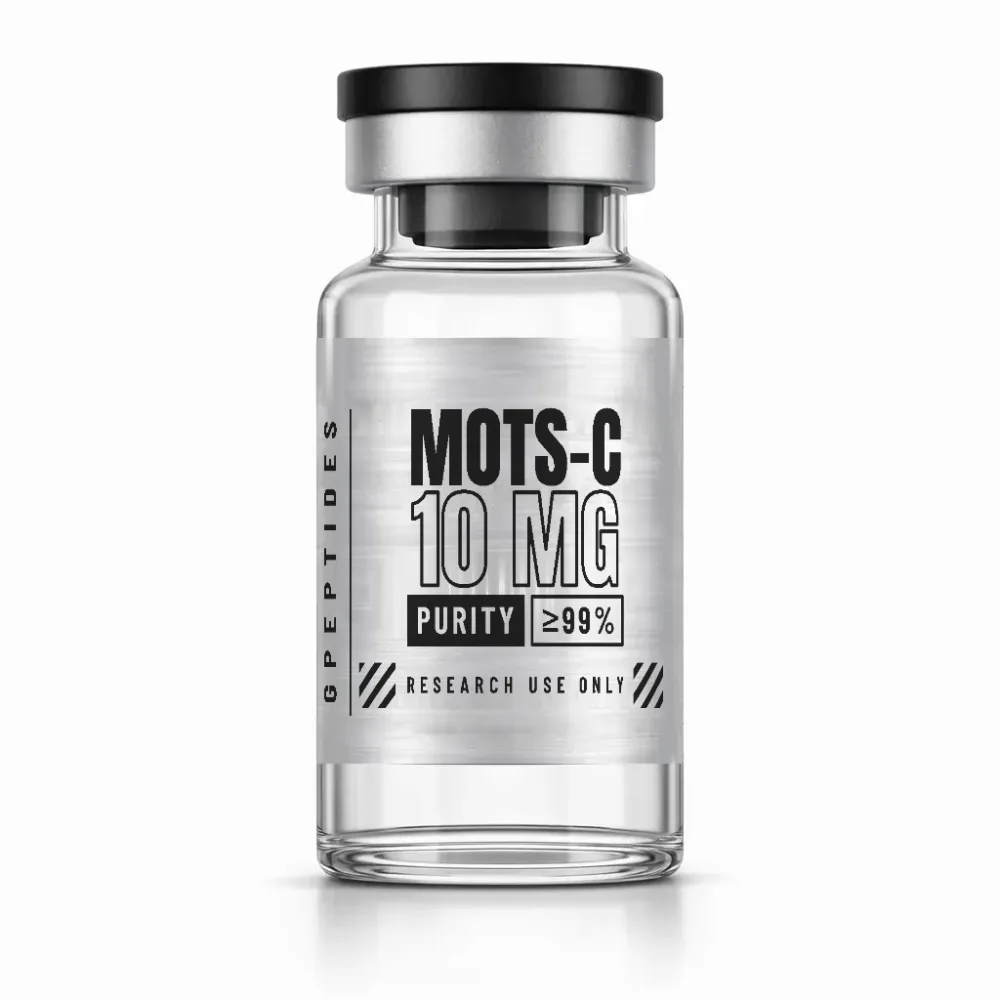
GPeptides offers MOTS-c exclusively as a laboratory reagent for in-vitro research. It is not intended for use in or on the human or animal body and is not placed on the market as a medicinal product, a food or a cosmetic. GPeptides gives no information on use or effects. The reagent is listed on the product page MOTS-c, with an overview in the Mitochondrial Peptides category.
Related categories: Mitochondrial Peptides
Related products
Related guides
HPLC and mass spectrometry: basics of peptide analytics
Two methods, two questions: HPLC answers “how pure?”, mass spectrometry “is it the right molecule?”. What lies behind peak, retention time and m/z.
Read more: HPLC and mass spectrometry: basics of peptide analytics →How to read a certificate of analysis (COA)
Test method, purity in percent, test date, laboratory: a COA is only as good as the information it contains. How to check whether a certificate matches the vial in your hand.
Read more: How to read a certificate of analysis (COA) →Storing lyophilised peptides: temperature, light, humidity
Dry, cold, dark: lyophilisates are robust but not indestructible. The key rules for unopened vials, opened vials and solutions.
Read more: Storing lyophilised peptides: temperature, light, humidity →