- Home
- Shop
- Incretin Analogues
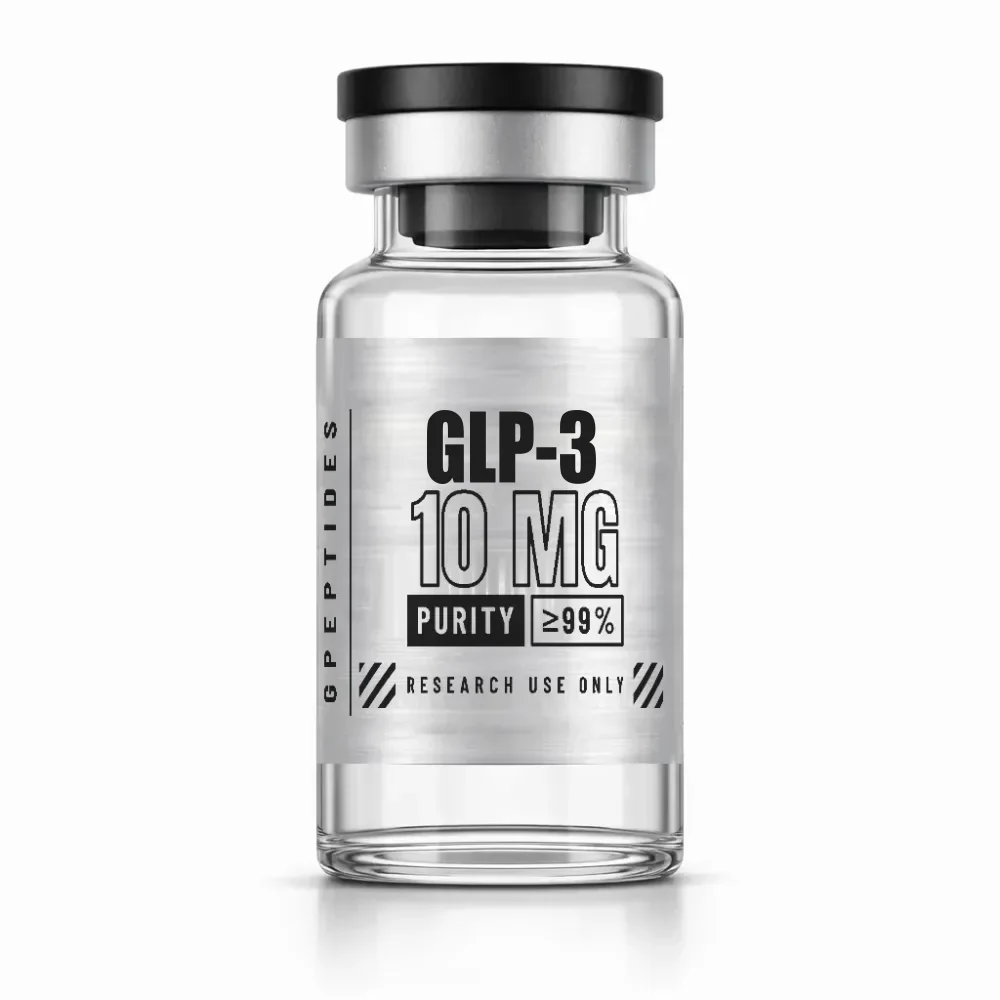
- GLP-3 10 mg
GLP-1/GIP/glucagon≥98% Purity
GLP-3 10 mg
GLP-3 is a synthetic triagonist studied in research at the GLP-1, GIP and glucagon receptors. One of the most discussed metabolic research peptides of recent years.
FormLyophilized powder
AnalyticsHPLC / MS
COA09.09.2026
€49.90
incl. VAT, plus shipping
10 mg
Product information
GLP-3 is supplied as a lyophilised powder in a sealed vial. The product is intended exclusively for laboratory and research purposes and not for use in humans or animals.
The available test documents are kept in the lab section, so product and test report stay linked and traceable.
Quick profile
- Triple agonist (GLP-1 / GIP / glucagon)
- Subject of current metabolic studies
- HPLC-tested purity, lyophilized
About GLP-3
What is GLP-3?
GLP-3 is the catalogue name for a synthetic, lipidated peptide that is listed in the scientific literature as a triple agonist: it addresses the GIP receptor, the GLP-1 receptor and the glucagon receptor. Other names in use are GIP/GLP-1/glucagon triagonist or triple agonist of the incretin and glucagon family. There is no endogenous hormone called GLP-3; the name is a trade designation, not official nomenclature. The molecule can be identified unambiguously by its CAS number.
Structure and key data
The backbone of the chain is derived from glucose-dependent insulinotropic polypeptide (GIP) and is substituted with other amino acids at several positions. In addition, a fatty diacid with 20 carbon atoms is attached to the peptide. This lipidation distinguishes GLP-3 from unmodified peptide chains and shapes its physicochemical properties.
- CAS number: 2381089-83-2
- Molecular formula: C221H342N46O68
- Molar mass: approx. 4731 g/mol (free peptide, without counter-ions)
- Composition: single peptide, not a blend
- Format: 10 mg, lyophilised in a glass vial
Place among the incretin analogues
Peptides of this substance class can be grouped by how many receptors they address: GLP-1 mono-agonists target the GLP-1 receptor alone, dual agonists two receptors, such as the GIP and GLP-1 receptors. GLP-3 extends this profile to include the glucagon receptor and so combines three targets in a single chain. In the GLP-3 + GHK-Cu set, the peptide is available together with a separate vial of the copper peptide GHK-Cu; the two molecules belong to different substance classes and share no structural features. A thematic neighbour is MOTS-c, a mitochondrially encoded peptide from metabolic and mitochondrial research that is structurally unrelated to GLP-3.
Research context
GLP-3 is studied mainly in receptor pharmacology and in preclinical metabolic models. What is of interest is that a single molecule addresses three receptors of the incretin and glucagon family; research questions concern, for example, how activity is distributed across the three target receptors. This description places the reagent in its scientific context and is not a statement about effects. Background on naming, receptor profile and storage is given in the guide to GLP-3.
Analytics at GPeptides
GLP-3 is regularly tested externally by HPLC and mass spectrometry. In the reversed-phase HPLC customary for peptides, the fatty-acid side chain contributes to the hydrophobicity of the molecule and helps determine the retention time; purity is derived from the area share of the main peak. Mass spectrometry compares the measured mass with the average of around 4731 Da calculated from the molecular formula. With electrospray ionisation, a peptide of this size appears as a series of multiply charged ions; for the quadruply protonated molecule the calculated value is m/z ≈ 1184. The available certificates of analysis (COA) can be found in the lab area; without a published certificate, the product is marked there as “pending”. How chromatogram and mass spectrum work together is explained in the guide HPLC and mass spectrometry.
Specifications
The relevant product data is part of the page content: form, purity, test method and intended use.
| Form | Lyophilized powder |
|---|---|
| Purity | ≥98% |
| Test methods | HPLC / MS |
| Unit | 10 mg |
| Category | Incretin Analogues |
| SKU | GP-0001 |
Use
Research Use Only. All products are intended exclusively for scientific in-vitro research and not for human or animal use.
| Use | Research only (in-vitro) |
|---|---|
| Storage | Dry & cool · −20 °C long-term |
Lab certificates
Quality assurance
Externally tested, traceably documented.
Identity and purity are regularly tested externally by HPLC and mass spectrometry. The available certificates of analysis are filed in the lab section.
View all lab certificates →Current report
Certificate of Analysis (COA)
| Tested on | 09.09.2026 |
|---|---|
| Purity | 99 |
| Test methods | HPLC / LC-MS |
| Test date | 09/26 |
Frequently asked questions
Is GLP-3 an endogenous hormone?
No. There is no endogenous hormone called GLP-3. The designation is a catalogue name for a synthetic triple agonist at the GIP, GLP-1 and glucagon receptors; identity is defined by CAS number 2381089-83-2.
What are the molecular formula and mass of GLP-3?
The molecular formula is C221H342N46O68, and the average molar mass is around 4731 g/mol. Both values refer to the free peptide without counter-ions from purification.
What does lipidation mean in the case of GLP-3?
A fatty diacid with 20 carbon atoms is attached to the GIP-derived peptide backbone. This is analytically relevant because the side chain increases hydrophobicity and thus helps determine how the peptide behaves in HPLC.
How does GLP-3 differ from the GLP-3 + GHK-Cu set?
The single product contains only GLP-3. The set combines GLP-3 with a separate vial of the copper peptide GHK-Cu; the amounts in both vials are stated on the product page of the set.
What is this product for?
Exclusively for scientific in-vitro research and laboratory use. Not for human or animal use, not for diagnostic or therapeutic purposes.
How is the peptide supplied?
As a lyophilized (freeze-dried) powder in a sealed vial. For reconstitution in a research context, bacteriostatic water is typically used.
How do I store it?
Unopened and lyophilized: cool, dry and protected from light; for long-term storage at −20 °C. Reconstituted: refrigerated and used promptly.
Is there a Certificate of Analysis (COA)?
Published certificates of analysis are listed by product in the Lab section. If no report is available for a product yet, it is marked as “pending” there.
Related products
Related guides
GLP-3: triple agonist for in-vitro research
GLP-3 is a synthetic peptide that addresses the GIP, GLP-1 and glucagon receptors. This guide covers its structure, receptor profile, laboratory testing and storage for in-vitro research.
Read more: GLP-3: triple agonist for in-vitro research →BPC-157: structure, analytics and handling in research
BPC-157 is a synthetic pentadecapeptide without end-group modification whose sequence is traced back to a gastric juice protein described in the literature. This guide explains the naming, structure, distinction from related fragments, analytics and storage of the reagent.
Read more: BPC-157: structure, analytics and handling in research →TB-500: structure, analytics and handling in research
TB-500 denotes the N-terminally acetylated heptapeptide Ac-LKKTETQ from thymosin β4. This guide explains the naming, the structure and the distinction from related molecules, as well as the analytics and storage of the laboratory reagent.
Read more: TB-500: structure, analytics and handling in research →