Bestseller
≥98%G
Incretin Analogues≥98% Purity
Lipidated amylin analogue (CAS 1415456-99-3) for in vitro research on the amylin and calcitonin receptor system.
incl. VAT, plus shipping
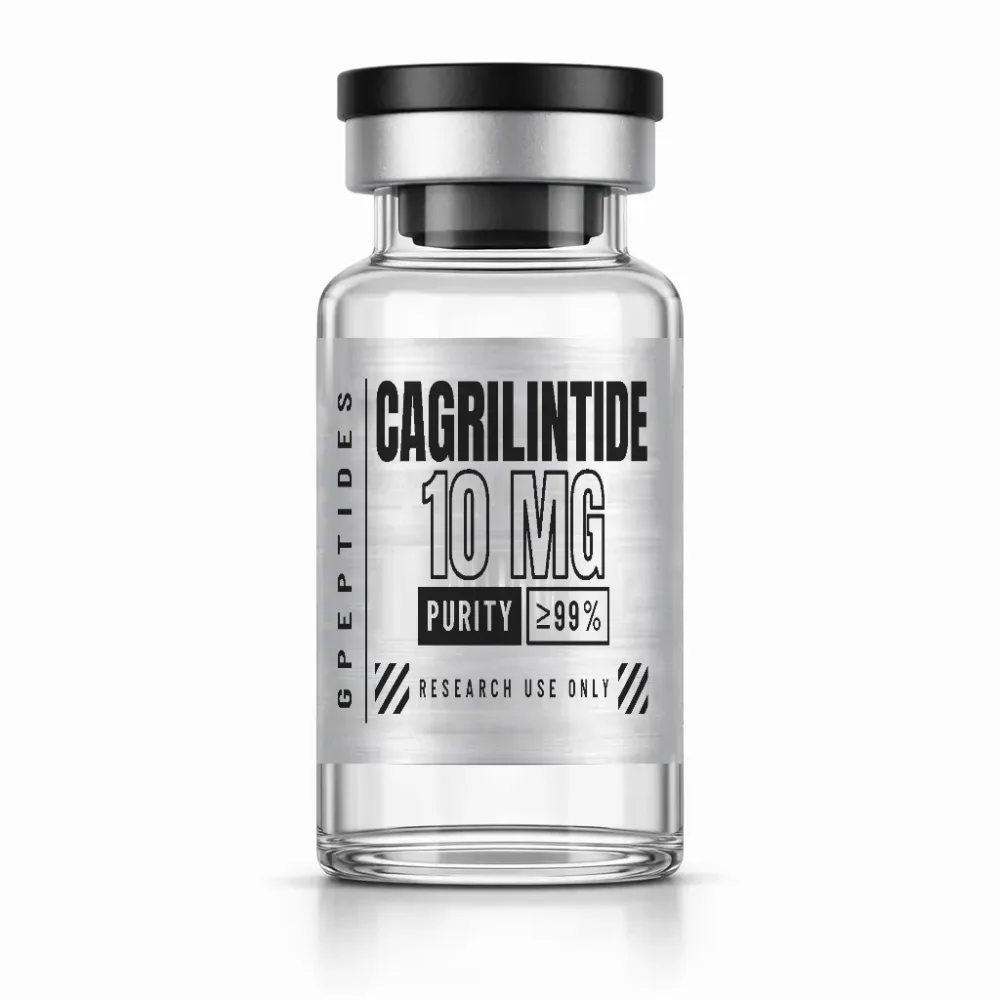
Cagrilintide is supplied as a lyophilised powder in a sealed vial. The product is intended exclusively for laboratory and research purposes and not for use in humans or animals.
The available test documents are kept in the lab section, so product and test report stay linked and traceable.
Guide · Cagrilintide: structure, analytics and handling in research →
Cagrilintide is the INN of a synthetic peptide, usually spelt Cagrilintid in German. It is one of the amylin analogues: its chain of 37 amino acids follows the structure of human amylin (IAPP), but is modified at six positions and lipidated. Pharmacologically, cagrilintide is regarded as a non-selective agonist at the amylin receptors AMY1, AMY2 and AMY3 and at the calcitonin receptor (CTR). Each amylin receptor is a complex of the calcitonin receptor and one receptor activity-modifying protein (RAMP1, RAMP2 or RAMP3).
Compared with human amylin, cagrilintide carries glutamic acid at position 14 and arginine at position 17, a pair designed to form a helix-stabilising salt bridge. In addition, there are prolines at positions 25, 28, 29 and 37. A fatty diacid with 20 carbon atoms is attached to the α-amino terminus of Lys1 via an L-γ-glutamyl linker; the C-terminus is amidated.
Cagrilintide shares its chain length and disulfide bridge with human amylin; the natural peptide, however, ends in a tyrosinamide and is not lipidated. The analogue pramlintide already contains prolines 25, 28 and 29; cagrilintide additionally replaces asparagine 14, valine 17 and tyrosine 37. At 32 amino acids, salmon calcitonin is shorter, but it likewise ends in a prolinamide and binds to the calcitonin receptor, the common core of the amylin receptors. Cagrilintide is listed in the Incretin Analogues category, although it is not derived from an incretin: GLP-3, for example, is derived from GIP and addresses the receptors for GIP, GLP-1 and glucagon, whereas cagrilintide addresses the calcitonin receptor family. What the two have in common is the C20 fatty diacid.
Cagrilintide is studied in in-vitro and preclinical research on the amylin and calcitonin receptor system. As the same molecule addresses the calcitonin receptor alone and all three RAMP complexes, it can be used to compare how the respective RAMP subunit alters ligand recognition. This describes a subject of research, not an effect in a living organism. More on naming and structure can be found in the guide to cagrilintide.
The vial contains 10 mg of lyophilised peptide with a stated purity of ≥ 98 %. Cagrilintide is regularly tested externally by HPLC and mass spectrometry; in reversed-phase HPLC, the C20 side chain prolongs retention, and the purity figure is based on the area share of the main peak. After electrospray ionisation, multiply protonated ions appear; calculated from the average mass, they lie at m/z 1470.7 (3+), 1103.3 (4+) and 882.8 (5+). At around 4.4 kDa, the monoisotopic signal reaches only about a third of the most intense isotope peak (M+2). If the fatty-acid γGlu side chain is missing, the average mass falls by around 453.6 Da; an opened disulfide bridge increases it by about 2 Da, which only high-resolution spectra detect reliably. Where a certificate of analysis (COA) is available, you will find it in the lab area; if it is missing there, the test is marked as “pending”. The basics are explained in the guide HPLC and mass spectrometry.
The relevant product data is part of the page content: form, purity, test method and intended use.
| Form | Lyophilized powder |
|---|---|
| Purity | ≥98% |
| Test methods | HPLC / MS |
| Unit | 10 mg |
| Category | Incretin Analogues |
| SKU | GP-0102 |
Research Use Only. All products are intended exclusively for scientific in-vitro research and not for human or animal use.
| Use | Research only (in-vitro) |
|---|---|
| Storage | Dry & cool · −20 °C long-term |
Quality assurance
Identity and purity are regularly tested externally by HPLC and mass spectrometry. The available certificates of analysis are filed in the lab section.
View all lab certificates →Current report
The certificate for this product will be published in the lab section as soon as it is available.
View all lab certificates →Yes. Cagrilintide is the international non-proprietary name (INN); Cagrilintid is the usual German spelling. The peptide is unambiguously identified by CAS number 1415456-99-3 and PubChem CID 171397054.
Compared with human amylin, cagrilintide is modified at six positions (N14E, V17R, A25P, S28P, S29P, Y37P) and acylated at the N-terminus with a C20 fatty diacid via a γGlu linker. Pramlintide differs from amylin only in the three prolines at positions 25, 28 and 29 and is not lipidated.
Cagrilintide is regarded as a non-selective agonist at the calcitonin receptor and at the amylin receptors AMY1, AMY2 and AMY3. Each of these three consists of the calcitonin receptor and one of the accessory proteins RAMP1, RAMP2 or RAMP3.
The molecular formula C194H312N54O59S2 gives a monoisotopic mass of 4406.25 Da and an average mass of around 4409.1 Da. Calculated from the average mass, the quadruply protonated ion formed by electrospray ionisation lies at m/z 1103.3; its monoisotopic peak appears at m/z 1102.57.
Exclusively for scientific in-vitro research and laboratory use. Not for human or animal use, not for diagnostic or therapeutic purposes.
As a lyophilized (freeze-dried) powder in a sealed vial. For reconstitution in a research context, bacteriostatic water is typically used.
Unopened and lyophilized: cool, dry and protected from light; for long-term storage at −20 °C. Reconstituted: refrigerated and used promptly.
Published certificates of analysis are listed by product in the Lab section. If no report is available for a product yet, it is marked as “pending” there.
Cagrilintide is a lipidated analogue of human amylin comprising 37 amino acids, with six substitutions, a disulfide bridge and a C20 fatty diacid bound via γ-glutamic acid. This guide explains its naming, its structure and how it differs from amylin, pramlintide and calcitonin, as well as the analytics and storage of the laboratory reagent.
Read more: Cagrilintide: structure, analytics and handling in research →Semax and Selank are linear heptapeptides with the same Pro-Gly-Pro ending, but they differ in origin and charge character. This guide explains their structure, how they differ from related molecules, expected masses, typical by-products and the storage of the lyophilisates.
Read more: Semax and Selank: structure, analytics and handling in research →Tesamorelin is an N-terminally acylated analogue of human GHRH comprising 44 amino acids. This guide explains its naming, its structure and how it differs from related peptides, as well as the analytics and storage of the laboratory reagent.
Read more: Tesamorelin: structure, analytics and handling in research →