Bestseller
≥98%G
GHRH/GHRP blend≥98% Purity
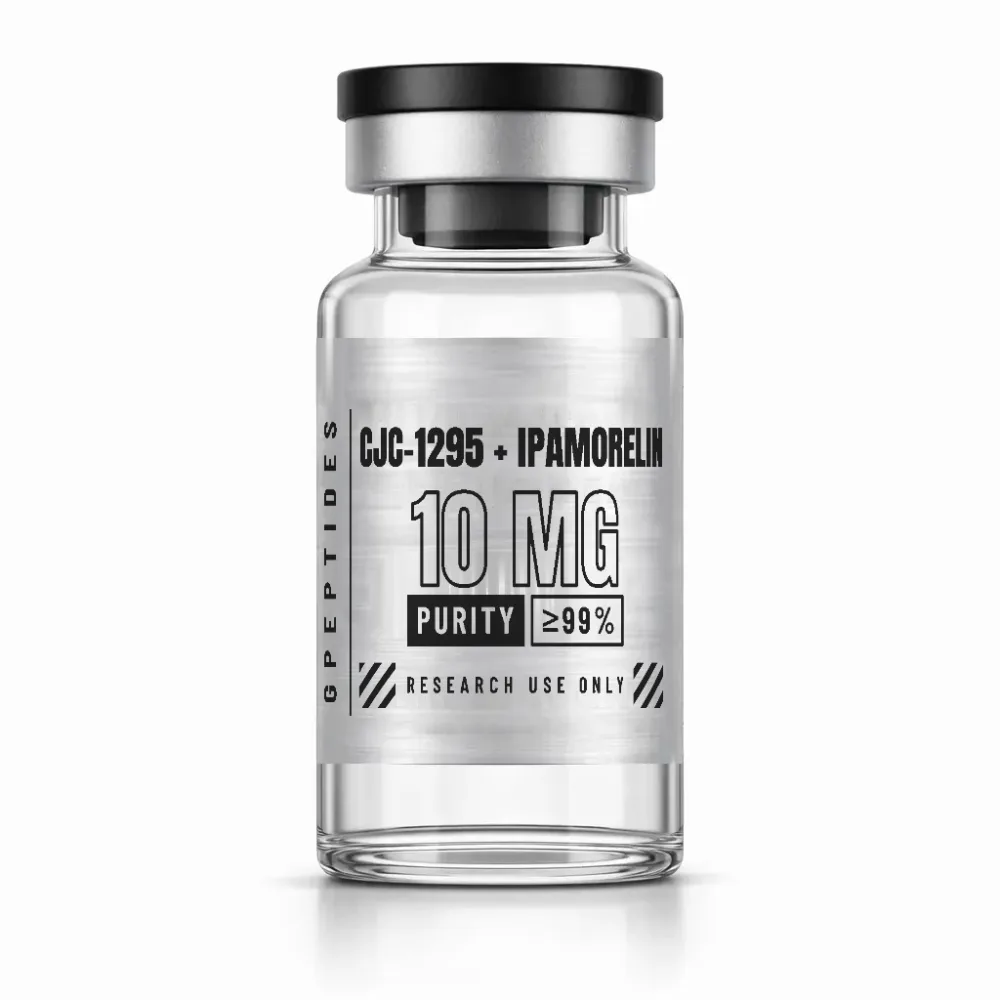
The combination of CJC-1295 and Ipamorelin is studied in research as a complementary GH-secretagogue pair.
incl. VAT, plus shipping
CJC-1295 + Ipamorelin is supplied as a lyophilised powder in a sealed vial. The product is intended exclusively for laboratory and research purposes and not for use in humans or animals.
The available test documents are kept in the lab section, so product and test report stay linked and traceable.
Guide · CJC-1295 and Ipamorelin: structure, analytics and handling in research →
This product combines two synthetic peptides from different families in one shared, freeze-dried vial. CJC-1295 is an analogue of growth-hormone-releasing hormone (GHRH), Ipamorelin a pentapeptide from the group of growth-hormone-releasing peptides (GHRP). Because both substances are present in the same lyophilisate, this is a blend and not a set of two vials. The product name gives both components, and the figure of 10 mg refers to their sum.
CJC-1295 is almost five times as heavy as Ipamorelin, and the two molecules go back to independent sequence lines: CJC-1295 to endogenous GHRH, Ipamorelin to a series of GHRP-1 modifications lacking its central Ala-Trp motif.
The name CJC-1295 is ambiguous. In the original scientific literature it denotes a form with a drug affinity complex (DAC), in which an additional lysine with a maleimidopropionyl group sits at the C-terminus for coupling to albumin. In the research-chemical trade, by contrast, “CJC-1295 no DAC” stands for the chain without this attachment, also known as Mod GRF(1-29). The two forms are around 279 Da apart and can be assigned unambiguously by mass spectrometry:
As a single substance, the catalogue lists CJC-1295 (No DAC).
CJC-1295 and Ipamorelin belong to the growth hormone axis between the hypothalamus and the pituitary, but they target different receptors there: CJC-1295 the GHRH receptor of the anterior pituitary, Ipamorelin the GH secretagogue receptor, also referred to as the ghrelin receptor (GHS-R1a). In research catalogues the two often appear as a pair because they represent two separate receptor systems of the same axis. They are studied in in-vitro assays with pituitary cells and in preclinical animal models, among other things on pharmacokinetics. The single substance Ipamorelin and the GHRH analogue Tesamorelin are listed in the GHRH & GHRP category.
For the blend, the analytics have to capture both peptides side by side. HPLC separates the short and the long chain into signals of their own. Mass spectrometry detects Ipamorelin at around 712 Da and assigns the CJC-1295 component, by its mass, to the form with or without DAC; large peptides of this kind typically appear as multiply charged ions, from which the molecular mass is back-calculated. The product is regularly tested by an independent external laboratory using HPLC and mass spectrometry. Available certificates of analysis are in the lab area; where no certificate is available yet, the testing is marked as pending.
The relevant product data is part of the page content: form, purity, test method and intended use.
| Form | Lyophilized powder |
|---|---|
| Purity | ≥98% |
| Test methods | HPLC / MS |
| Unit | 10 mg |
| Category | Sets & Bundles |
| SKU | GP-0003 |
Research Use Only. All products are intended exclusively for scientific in-vitro research and not for human or animal use.
| Use | Research only (in-vitro) |
|---|---|
| Storage | Dry & cool · −20 °C long-term |
Quality assurance
Identity and purity are regularly tested externally by HPLC and mass spectrometry. The available certificates of analysis are filed in the lab section.
View all lab certificates →Current report
The certificate for this product will be published in the lab section as soon as it is available.
View all lab certificates →DAC stands for drug affinity complex: an additional lysine with a maleimidopropionyl group at the C-terminus, designed for coupling to albumin. The form without this attachment is referred to in the trade as “no DAC” or Mod GRF(1-29).
GHRH analogues are derived from the sequence of hypothalamic GHRH and are assigned to the GHRH receptor. GHRPs are short synthetic peptides with no sequence relationship to GHRH and are assigned to the GH secretagogue receptor.
No. 10 mg is the total fill weight of the vial, that is the sum of CJC-1295 and Ipamorelin.
Yes. CJC-1295 (No DAC) and Ipamorelin are available as separate products in the category for GHRH and GHRP peptides. In the blend, by contrast, both are present together in one vial.
Exclusively for scientific in-vitro research and laboratory use. Not for human or animal use, not for diagnostic or therapeutic purposes.
As a lyophilized (freeze-dried) powder in a sealed vial. For reconstitution in a research context, bacteriostatic water is typically used.
Unopened and lyophilized: cool, dry and protected from light; for long-term storage at −20 °C. Reconstituted: refrigerated and used promptly.
Published certificates of analysis are listed by product in the Lab section. If no report is available for a product yet, it is marked as “pending” there.
CJC-1295 (No DAC) and Ipamorelin come from two separate peptide families of the GH axis and are listed in the catalogue both individually and as a blend. This guide explains their naming, chemical modifications, expected masses, typical by-products and how to handle the lyophilisate in the laboratory.
Read more: CJC-1295 and Ipamorelin: structure, analytics and handling in research →MT1 and MT2 are two structurally distinct analogues of α-MSH: a linear chain of 13 residues and a heptapeptide closed by a lactam bridge. This guide explains the naming, structure, expected masses, typical by-products and storage of the lyophilisates.
Read more: Melanotan I and II: structure, analytics and handling in research →In GHK-Cu, the unmodified tripeptide Gly-His-Lys binds a copper(II) ion. This guide explains the naming, the copper binding, the distinction from related molecules, the expected masses in the certificate of analysis, and the storage and handling of the reagent.
Read more: GHK-Cu: structure, analytics and handling in research →