Bestseller
≥98%G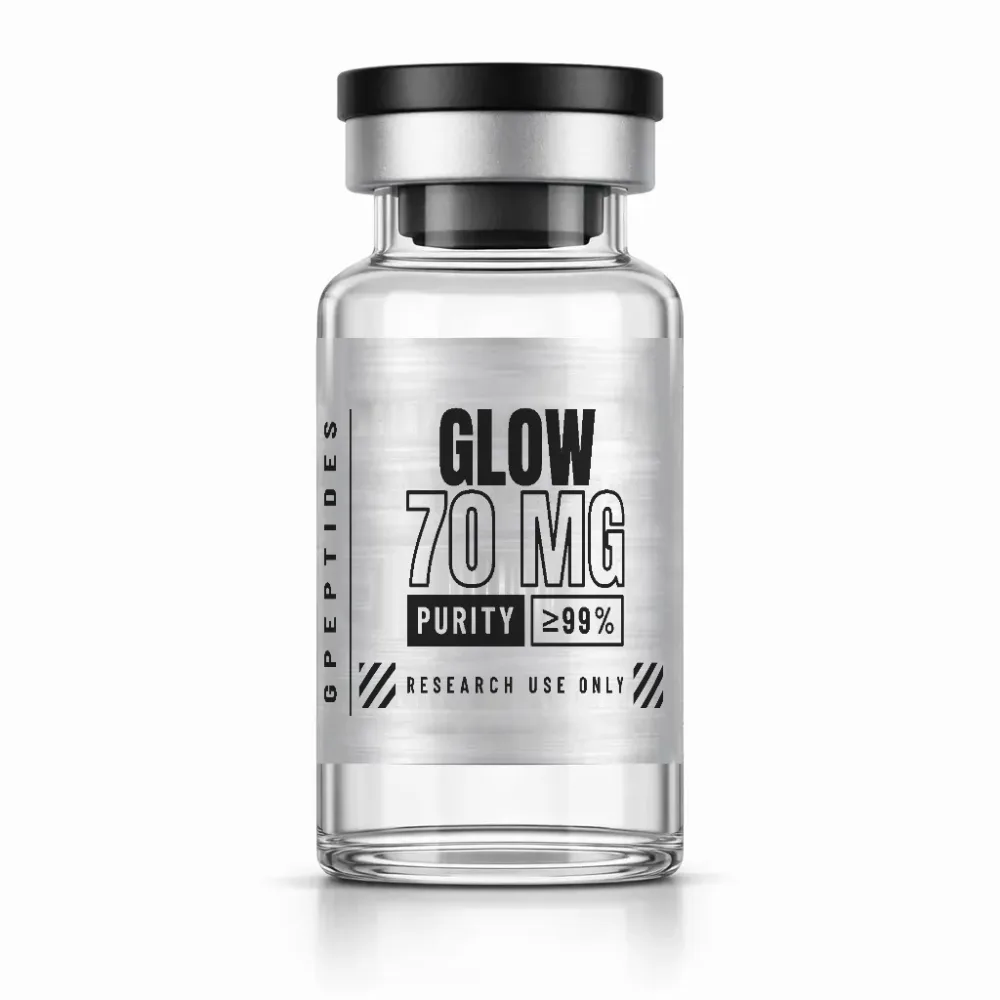
Research bundle≥98% Purity
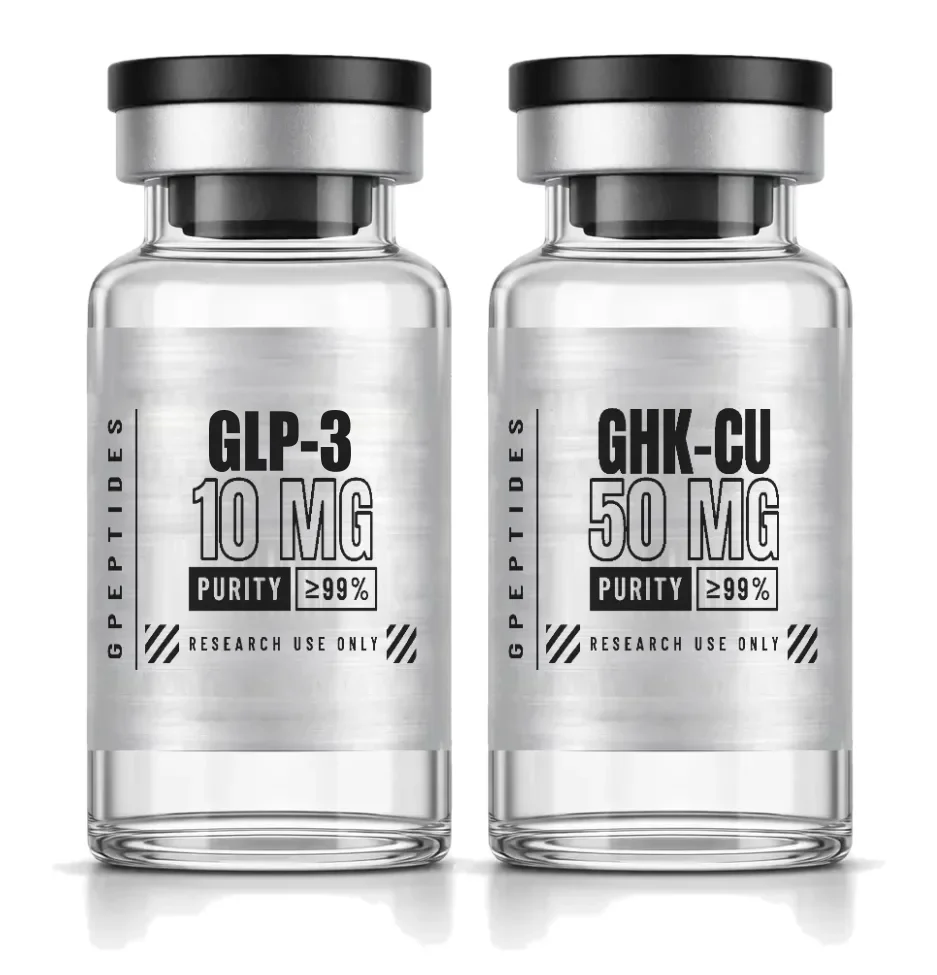
A set of GLP-3 and GHK-Cu, combined for broad metabolic and regenerative research approaches.
incl. VAT, plus shipping
GLP-3 + GHK-Cu is supplied as a lyophilised powder in a sealed vial. The product is intended exclusively for laboratory and research purposes and not for use in humans or animals.
The available test documents are kept in the lab section, so product and test report stay linked and traceable.
GLP-3 + GHK-Cu is a research set of two separately filled, freeze-dried vials. According to the label, one vial contains 10 mg of GLP-3 and the other 50 mg of GHK-Cu. Unlike in a blend, the two substances therefore do not come into contact with each other and can be stored, handled and analysed independently. Chemically, a great deal separates them: on one side a long-chain, lipidated peptide of around 4731 g/mol, on the other a copper complex of just three amino acids.
GLP-3 is a catalogue name, not official nomenclature. The synthetic peptide has a backbone derived from GIP (glucose-dependent insulinotropic polypeptide) with several amino acid substitutions, to which a C20 fatty diacid is attached. In the scientific literature it is classified as a triple agonist at the GIP, GLP-1 and glucagon receptors. It can be identified by the molecular formula C221H342N46O68, the molar mass of around 4731 g/mol and the CAS number 2381089-83-2.
GHK-Cu is the copper(II) complex of the tripeptide glycyl-L-histidyl-L-lysine. The tripeptide occurs in the human body; its affinity for copper(II) ions resembles that of the copper transport site of albumin. The free tripeptide has the molecular formula C14H24N6O4, a molar mass of 340.38 g/mol and the CAS number 49557-75-7. The copper complex is listed in databases under entries of its own, whose formula and mass depend on stoichiometry and counter-ion.
The set is not based on a shared molecular class. GLP-3 belongs to metabolic research on signalling at the GIP, GLP-1 and glucagon receptors, GHK-Cu to cell culture and animal studies on copper-binding peptides and on remodelling of the extracellular matrix. The set does not imply any connection between the two fields of research; it bundles two reagents from the catalogue into one order at a set price. GLP-3 and GHK-Cu are also available individually; their structural classification is given in the categories Incretin Analogues and Melanocortins & Copper Peptides.
Because GLP-3 and GHK-Cu are supplied in separate vials, each substance can be analysed on its own without signals from the other overlapping the result. For GLP-3, mass spectrometry compares the measured value with the calculated mass of around 4731 Da; a molecule this large and lipidated usually appears in the spectrum as a series of multiply charged ions. For GHK-Cu the tripeptide at 340.38 Da serves as the reference, with the copper complex correspondingly higher. HPLC gives the area share of the main peak in each case. An independent external laboratory tests both reagents at regular intervals by HPLC and mass spectrometry; which certificates are already available can be seen in the lab area, where documents still outstanding are marked as pending. Background on the naming and structure of GLP-3 is provided in the guide to GLP-3.
The relevant product data is part of the page content: form, purity, test method and intended use.
| Form | Lyophilized powder |
|---|---|
| Purity | ≥98% |
| Test methods | HPLC / MS |
| Unit | 2 Vials |
| Category | Sets & Bundles |
| SKU | GP-0014 |
Research Use Only. All products are intended exclusively for scientific in-vitro research and not for human or animal use.
| Use | Research only (in-vitro) |
|---|---|
| Storage | Dry & cool · −20 °C long-term |
Quality assurance
Identity and purity are regularly tested externally by HPLC and mass spectrometry. The available certificates of analysis are filed in the lab section.
View all lab certificates →Current report
The certificate for this product will be published in the lab section as soon as it is available.
View all lab certificates →No. The set consists of two separate vials, according to the label with 10 mg of GLP-3 and 50 mg of GHK-Cu. Each substance is present as a lyophilisate of its own.
No, it is a catalogue name. The peptide is identified unambiguously by its CAS number 2381089-83-2; in the literature it is classified as an agonist at the GIP, GLP-1 and glucagon receptors.
Hardly. GLP-3 is a long, lipidated peptide chain, GHK-Cu a metal complex of three amino acids and a copper(II) ion. Their fields of research, metabolic receptors on the one hand and copper-binding peptides on the other, do not overlap either.
Yes, both are in the catalogue as individual products. The set contains the same substances in two vials at a set price.
Exclusively for scientific in-vitro research and laboratory use. Not for human or animal use, not for diagnostic or therapeutic purposes.
As a lyophilized (freeze-dried) powder in a sealed vial. For reconstitution in a research context, bacteriostatic water is typically used.
Unopened and lyophilized: cool, dry and protected from light; for long-term storage at −20 °C. Reconstituted: refrigerated and used promptly.
Published certificates of analysis are listed by product in the Lab section. If no report is available for a product yet, it is marked as “pending” there.
GLP-3 is a synthetic peptide that addresses the GIP, GLP-1 and glucagon receptors. This guide covers its structure, receptor profile, laboratory testing and storage for in-vitro research.
Read more: GLP-3: triple agonist for in-vitro research →In GHK-Cu, the unmodified tripeptide Gly-His-Lys binds a copper(II) ion. This guide explains the naming, the copper binding, the distinction from related molecules, the expected masses in the certificate of analysis, and the storage and handling of the reagent.
Read more: GHK-Cu: structure, analytics and handling in research →From Germany to the laboratory: how vials are packed, which transit times apply, when a tracking number arrives and what to check when the goods are received.
Read more: Shipping research peptides: packaging, transit times, receipt of goods →