Guides
GHK-Cu: structure, analytics and handling in research
In GHK-Cu, the unmodified tripeptide Gly-His-Lys binds a copper(II) ion. This guide explains the naming, the copper binding, the distinction from related molecules, the expected masses in the certificate of analysis, and the storage and handling of the reagent.
Research Use Only- Published2026-09-24
- Updated2026-09-24
- AuthorGPeptides editorial team (operator)
Overview and naming
GHK-Cu denotes a peptide–metal complex: the tripeptide GHK carries a bound copper(II) ion. The three letters are the one-letter codes of glycine (G), histidine (H) and lysine (K), and the suffix “-Cu” is the chemical symbol for copper. Variants such as Cu-GHK, copper tripeptide or copper peptide refer to the same complex, but not necessarily to the same stoichiometry or the same counter-ion.
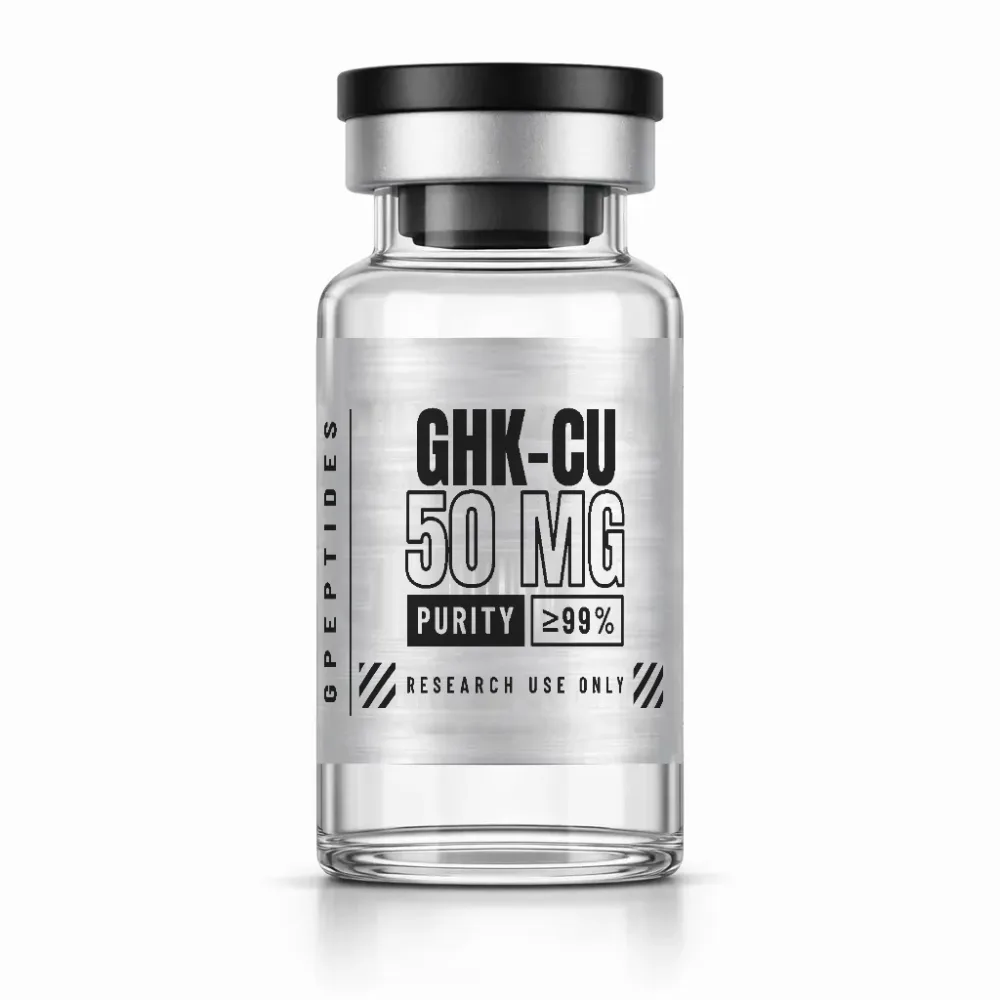
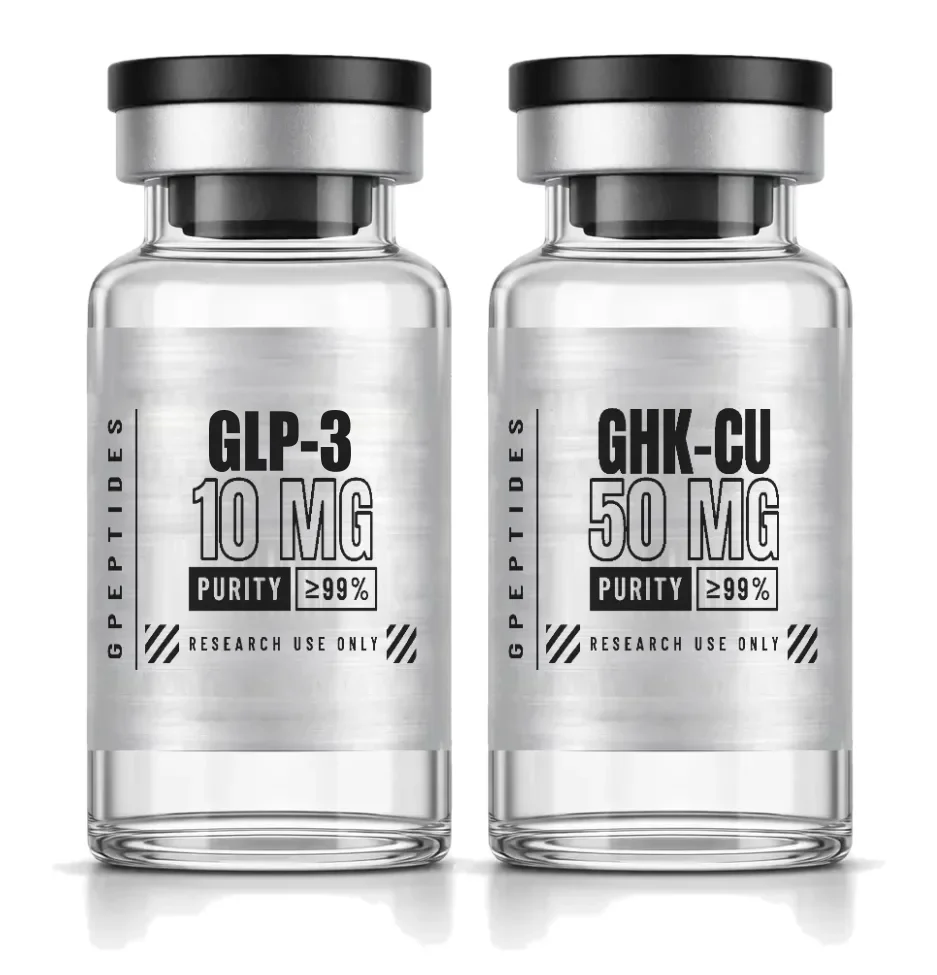
In the catalogue, the molecule appears in four products: “GHK-Cu” is the single vial, and in the set “GLP-3 + GHK-Cu” it occupies a vial of its own. “GLOW Stack” and “KLOW” are trade names for blends in which, by common market convention, GHK-Cu is one of several components in the same lyophilisate. The copper peptide can therefore only be analysed in isolation in the single vial and in the set.
Structure in detail
The sequence is Gly-His-Lys. Because glycine is the only achiral proteinogenic amino acid, the tripeptide has only two stereocentres, both in the L-configuration. Unlike many longer research peptides, GHK is not modified:
- No N-terminal acetylation: the free amino group of glycine is part of the copper-binding site. An acetyl group would block precisely this position.
- No C-terminal amidation: the lysine ends in a free carboxyl group.
- No cyclisation, no lipidation: what sets it apart lies solely in the metal binding.
According to structural data, the peptide coordinates the copper(II) ion via three nitrogen atoms: the amino group of glycine, the deprotonated amide nitrogen of the Gly-His bond and a nitrogen in the imidazole ring of histidine. Depending on the environment, a fourth position is occupied by water or a carboxylate group. The amino group of the lysine side chain remains unbound and may be protonated; depending on the form, the solid therefore also contains a counter-ion. The copper gives the lyophilisate a blue colour, whereas free GHK is a white powder.
Distinction from related molecules
- GHK without copper: the same sequence without the metal, around 340.4 g/mol. The free peptide (CAS 49557-75-7) and the copper complex (CAS 89030-95-5) are registered separately; a COA should make clear which form its figures refer to.
- KPV: also a tripeptide and almost the same weight, but derived from the C-terminus of α-MSH and not a metal complex. The protonated ions lie at m/z 341.19 (GHK) and 343.23 (KPV).
- Glutathione: a tripeptide with a γ-peptide bond and a free thiol group; its chemistry is shaped above all by redox reactions of the thiol group, and it is not present as a defined copper complex.
- MT1 and MT2: melanocortin analogues with 13 and seven amino acids respectively. They share the catalogue category but are receptor ligands, not metal complexes.
What to look for in analytics and the COA
Two groups of signals are possible in the mass spectrum, depending on whether the complex survives the measurement:
- Free peptide: [M+H]+ at around m/z 341.19; the doubly charged ion [M+2H]2+ at around m/z 171.10 and the sodium adduct [M+Na]+ at around m/z 363.18 are also possible.
- Copper complex: a singly charged ion of peptide and copper, formed with loss of one proton, at around m/z 402.11, accompanied by a second signal at around 404.11. The spacing of two mass units and an intensity ratio of about 7 : 3 correspond to the natural distribution of the isotopes copper-63 and copper-65.
In reversed-phase HPLC, GHK-Cu shows two peculiarities. The tripeptide is very polar and is only weakly retained on C18 material; in addition, the complex can dissociate in the usual acidic mobile phases, so that the chromatogram essentially reflects the peptide. Possible secondary peaks include cleavage products such as Gly-His and His-Lys, as well as deletion sequences from synthesis. Signals at +16 Da indicate oxidation; in copper peptides, the histidine residue is considered the main point of attack.
Purity is not the same as peptide content: HPLC purity is an area share among the UV-active signals and does not capture copper, counter-ions such as acetate or trifluoroacetate (TFA), or residual water. Even in the neutral 1:1 complex, at around 401.9 g/mol, just under 16 % of the mass is copper; counter-ions and moisture lower the peptide share further. Neither method quantifies the copper content itself. GHK-Cu is regularly tested externally by HPLC and mass spectrometry; the available certificates of analysis (COA) can be viewed in the lab area, where a certificate that is not yet available is marked as pending. The structure and meaning of a COA are explained in the guides Reading a certificate of analysis and Purity of research peptides.
Storage and handling in the laboratory
The basic rule: store cool, dry and protected from light, frozen for longer periods, and let the vial come to room temperature before opening. Details are described in the guide Storing lyophilised peptides. For GHK-Cu specifically, a few further points apply:
- Moisture: salts of short, basic peptides readily take up water. Open the vial only briefly, therefore, and reseal it immediately.
- Colour as a check: an evenly blue lyophilisate is typical. Marked changes in colour or clumping are a reason to check the certificate and the storage history.
- Chemical compatibility: strong chelating agents such as EDTA can strip the copper from the complex, and reducing additives such as dithiothreitol or thiols such as glutathione can reduce copper(II). Buffers and additives should be chosen accordingly when the intact complex is being studied.
Research context
GHK-Cu is studied in in-vitro and preclinical research. Typical questions concern the coordination chemistry of short copper peptides, copper exchange between peptides and proteins, and gene expression profiles and components of the extracellular matrix in cell models. Such findings describe the molecule under laboratory conditions and cannot be transferred to applications.
Research use only: legal notice
At GPeptides, GHK-Cu is offered exclusively as a laboratory reagent for in-vitro research. It is not intended for use in or on the human or animal body and is placed on the market neither as a medicinal product nor as a cosmetic product. GPeptides gives no instructions for use and makes no statements about effects; the analytics demonstrate the identity and purity of the reagent, nothing more. You will find the copper peptide as the single vial GHK-Cu and in the set GLP-3 + GHK-Cu; according to the usual market composition, it is also contained in the blends GLOW Stack and KLOW. Related peptides are listed in the Melanocortins & Copper Peptides category.
Related categories: Melanocortins & Copper Peptides
Related products
Related guides
How to read a certificate of analysis (COA)
Test method, purity in percent, test date, laboratory: a COA is only as good as the information it contains. How to check whether a certificate matches the vial in your hand.
Read more: How to read a certificate of analysis (COA) →Purity of research peptides: what the percentages mean
Purity is not the same as content. Anyone comparing COAs should be able to distinguish area percent, net peptide content and typical by-products of peptide synthesis.
Read more: Purity of research peptides: what the percentages mean →Storing lyophilised peptides: temperature, light, humidity
Dry, cold, dark: lyophilisates are robust but not indestructible. The key rules for unopened vials, opened vials and solutions.
Read more: Storing lyophilised peptides: temperature, light, humidity →