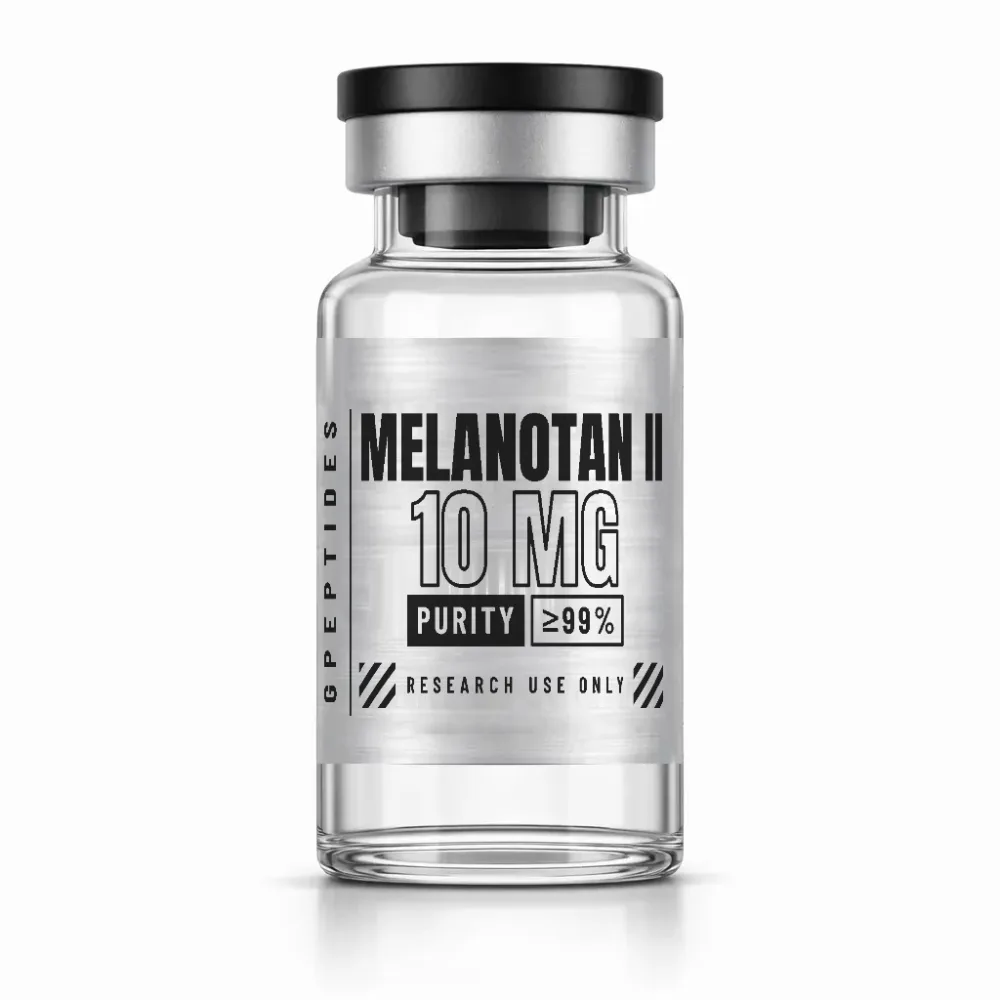
Melanocortin≥98% Purity
Melanotan II (MT2) 10 mg
Melanotan II (MT2) is a synthetic analog of α-MSH studied in research on melanocortin receptors.
FormLyophilized powder
AnalyticsHPLC / MS
COALab area
€29.90
incl. VAT, plus shipping
10 mg
Product information
Melanotan II (MT2) is supplied as a lyophilised powder in a sealed vial. The product is intended exclusively for laboratory and research purposes and not for use in humans or animals.
The available test documents are kept in the lab section, so product and test report stay linked and traceable.
Quick profile
- α-MSH analog
- Melanocortin-receptor research
- Cyclic heptapeptide
Guide · Melanotan I and II: structure, analytics and handling in research →
About Melanotan II (MT2)
What is MT2?
MT2 is the catalogue name for Melanotan II, also listed in the literature as MT-II or Melanotan-II. It is a fully synthetic, cyclic peptide from the melanocortin family. Its scaffold is derived from the core segment 4–10 of α-melanocyte-stimulating hormone (α-MSH), whose natural sequence comprises 13 amino acids. Pharmacologically, Melanotan II is classed as a non-selective agonist at melanocortin receptors: it addresses several subtypes of this receptor family rather than targeting a single one.
Structure and key data
MT2 is derived from this α-MSH core segment by four substitutions: norleucine at position 4, aspartic acid at position 5, D-phenylalanine at position 7 and lysine at position 10. The side chains of aspartic acid and lysine are joined to each other by an amide bond, known as a lactam bridge. This creates a ring of six amino acids, preceded by the acetylated norleucine; the C-terminus is present as an amide.
- Sequence: Ac-Nle-cyclo[Asp-His-D-Phe-Arg-Trp-Lys]-NH2
- One-letter code of the core: XDHfRWK (X = norleucine, f = D-phenylalanine)
- Molecular formula: C50H69N15O9
- Molar mass: 1024.2 g/mol (free form, without counter-ions)
- CAS number: 121062-08-6
- PubChem CID: 92432
Classification: MT2 and related peptides
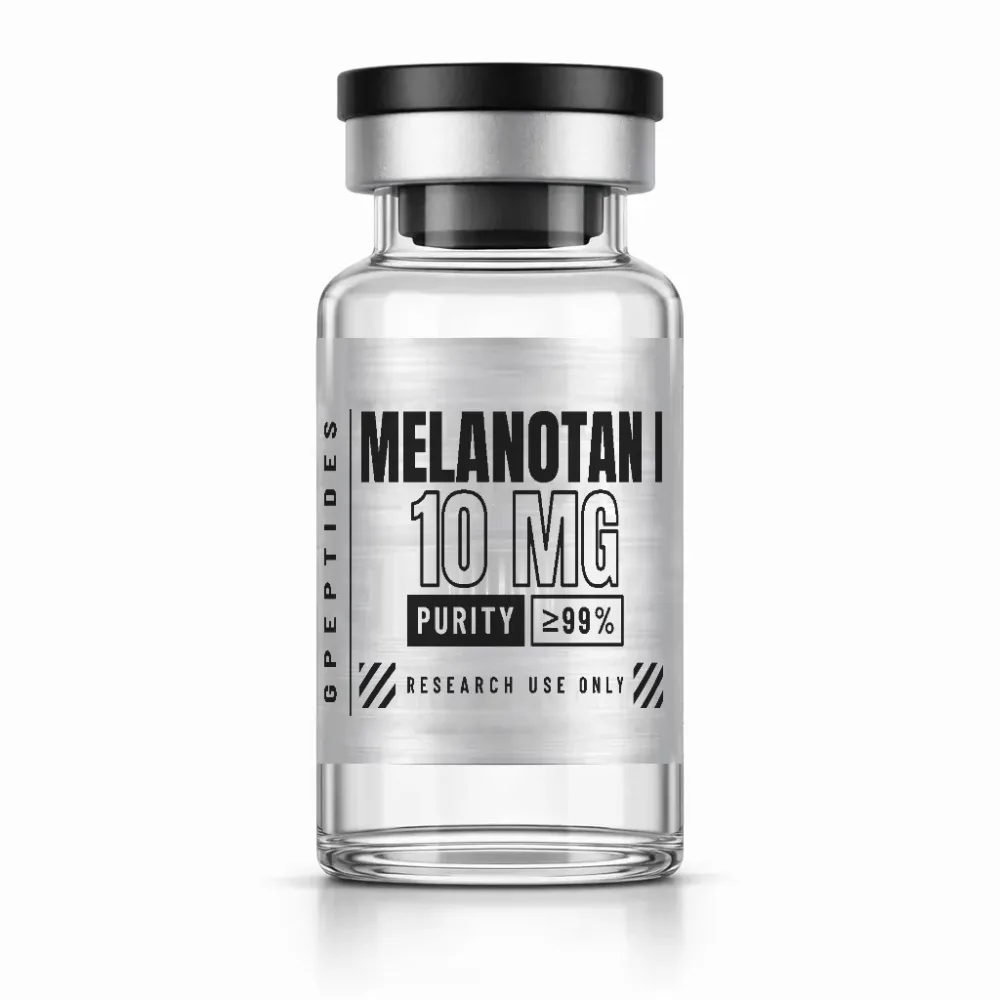
The same section of the catalogue lists MT1 (Melanotan I). Both are derived from α-MSH but differ fundamentally in structure: MT1 is a linear chain of 13 amino acids with only two substitutions compared with the natural sequence, whereas MT2 is shortened to seven residues and fixed in a ring by the lactam bridge. The literature assigns MT1 to the MC1 receptor, while MT2 is described as a non-selective agonist across several subtypes. KPV, the C-terminal tripeptide lysine-proline-valine, is also derived from the α-MSH sequence; this is precisely the section that MT2 lacks. An overview of all molecules in this group is given in the Melanocortins & Copper Peptides category.
Research context
In in-vitro and preclinical work, Melanotan II serves as a tool compound for studying the melanocortin system. At the cellular level this concerns, for example, signalling via the MC1 receptor in melanocyte cultures; in rodent models, central signalling pathways via the MC4 and MC3 receptors. Because the substance addresses several subtypes, it is used as a non-selective reference agonist in studies with knockout lines for individual receptors (such as MC3R or MC4R). The comparison between wild type and knockout then shows what proportion of a signal depends on a particular receptor.
Analytics at GPeptides
MT2 is listed as a 10 mg vial with a purity of ≥ 98 % (HPLC). Ideally, a single main peak dominates the chromatogram; secondary peaks can point, for instance, to truncated sequences or to ring precursors that have not been closed. Mass spectrometry checks identity against the molecular formula C50H69N15O9: the expected monoisotopic mass is around 1023.54 Da, the average mass around 1024.2 Da. Since the lactam bridge forms with the loss of water, an open, linear precursor lies about 18 Da higher – a difference that MS detects unambiguously. MT2 is regularly tested externally by HPLC and mass spectrometry; the measurements are carried out by an independent external laboratory. Available certificates of analysis (COA) can be found in the lab area; where no certificate has been filed, testing is considered pending. How to read the chromatogram and mass spectrum is explained in the guide HPLC and mass spectrometry.
Specifications
The relevant product data is part of the page content: form, purity, test method and intended use.
| Form | Lyophilized powder |
|---|---|
| Also known as | Melanotan II |
| Database | PubChem |
| Purity | ≥98% |
| Test methods | HPLC / MS |
| Unit | 10 mg |
| Category | Melanocortins & Copper Peptides |
| SKU | GP-0010 |
Use
Research Use Only. All products are intended exclusively for scientific in-vitro research and not for human or animal use.
| Use | Research only (in-vitro) |
|---|---|
| Storage | Dry & cool · −20 °C long-term |
Lab certificates
Quality assurance
Externally tested, traceably documented.
Identity and purity are regularly tested externally by HPLC and mass spectrometry. The available certificates of analysis are filed in the lab section.
View all lab certificates →Current report
Certificate of Analysis (COA)
The certificate for this product will be published in the lab section as soon as it is available.
View all lab certificates →Frequently asked questions
Is MT2 the same as Melanotan II?
Yes. MT2 is the catalogue name for Melanotan II, which is also listed in the literature as MT-II. The compound is registered under CAS number 121062-08-6 and PubChem CID 92432.
How does MT2 differ from MT1?
MT1 is a linear chain of 13 amino acids and is described as an agonist at the MC1 receptor. MT2 is a peptide shortened to seven residues and closed into a ring by a lactam bridge; it is regarded as a non-selective agonist at several melanocortin receptor subtypes.
How is the ring of MT2 closed?
By a lactam bridge, i.e. an amide bond between the side chains of aspartic acid and lysine. There is no disulfide bridge; the sequence contains no cysteine.
Which mass should mass spectrometry confirm for MT2?
The molecular formula C50H69N15O9 gives a monoisotopic mass of around 1023.54 Da and an average molar mass of 1024.2 g/mol. Both values refer to the free form without counter-ions.
What is this product for?
Exclusively for scientific in-vitro research and laboratory use. Not for human or animal use, not for diagnostic or therapeutic purposes.
How is the peptide supplied?
As a lyophilized (freeze-dried) powder in a sealed vial. For reconstitution in a research context, bacteriostatic water is typically used.
How do I store it?
Unopened and lyophilized: cool, dry and protected from light; for long-term storage at −20 °C. Reconstituted: refrigerated and used promptly.
Is there a Certificate of Analysis (COA)?
Published certificates of analysis are listed by product in the Lab section. If no report is available for a product yet, it is marked as “pending” there.
Related products
Related guides
Melanotan I and II: structure, analytics and handling in research
MT1 and MT2 are two structurally distinct analogues of α-MSH: a linear chain of 13 residues and a heptapeptide closed by a lactam bridge. This guide explains the naming, structure, expected masses, typical by-products and storage of the lyophilisates.
Read more: Melanotan I and II: structure, analytics and handling in research →How to read a certificate of analysis (COA)
Test method, purity in percent, test date, laboratory: a COA is only as good as the information it contains. How to check whether a certificate matches the vial in your hand.
Read more: How to read a certificate of analysis (COA) →HPLC and mass spectrometry: basics of peptide analytics
Two methods, two questions: HPLC answers “how pure?”, mass spectrometry “is it the right molecule?”. What lies behind peak, retention time and m/z.
Read more: HPLC and mass spectrometry: basics of peptide analytics →