Afamelanotide≥98% Purity
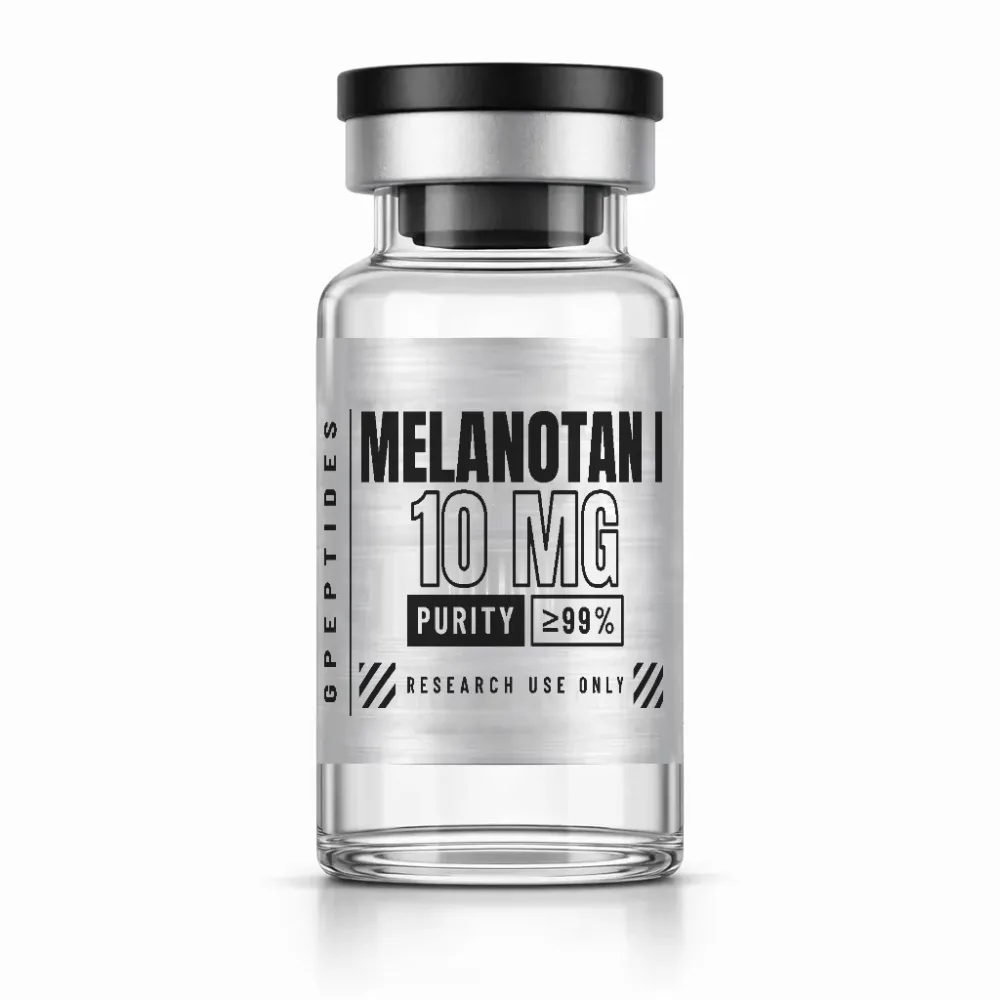
Melanotan I (MT1) 10 mg
Melanotan I (afamelanotide) is a linear α-MSH analog used in research on pigmentation pathways.
FormLyophilized powder
AnalyticsHPLC / MS
COALab area
€30.90
incl. VAT, plus shipping
10 mg
Product information
Melanotan I (MT1) is supplied as a lyophilised powder in a sealed vial. The product is intended exclusively for laboratory and research purposes and not for use in humans or animals.
The available test documents are kept in the lab section, so product and test report stay linked and traceable.
Quick profile
- Linear α-MSH analog
- Pigmentation research
- 13-amino-acid peptide
Guide · Melanotan I and II: structure, analytics and handling in research →
About Melanotan I (MT1)
What is MT1?
The abbreviation MT1 stands for Melanotan I, a linear peptide of 13 amino acids. Its international non-proprietary name (INN) is afamelanotide; in the biochemical literature the compound is also widely known as [Nle4, D-Phe7]-α-MSH or NDP-MSH (NDP-α-MSH). All of these names refer to the same molecule. MT1 is a synthetic analogue of α-melanocyte-stimulating hormone and is classified as an agonist at the melanocortin 1 receptor (MC1R).
Structure: two targeted substitutions
The sequence follows natural α-MSH (Ac-SYSMEHFRWGKPV-NH2) residue by residue – with two exceptions. At position 4, norleucine replaces methionine; at position 7, D-phenylalanine takes the place of L-phenylalanine. Norleucine has an unbranched side chain of the same length as that of methionine but carries no sulfur atom. The D-enantiomer at position 7 alters the spatial orientation within the His-Phe-Arg-Trp motif. In serum stability studies, the modified molecule was described as more resistant to degradation by serum enzymes than the natural sequence.
- Sequence: Ac-Ser-Tyr-Ser-Nle-Glu-His-D-Phe-Arg-Trp-Gly-Lys-Pro-Val-NH2
- Short form: Ac-SYS[Nle]EH[dF]RWGKPV-NH2
- Molecular formula: C78H111N21O19
- Molar mass: 1646.8 g/mol, based on the free peptide form
- CAS number: 75921-69-6
- PubChem CID: 16197727
MT1 compared with MT2 and KPV
Whereas MT1 retains the full length of α-MSH, MT2 (Melanotan II) reduces the molecule to a core of seven residues and closes it into a ring via a lactam bridge. The two also differ pharmacologically: the literature assigns MT1 to the MC1 receptor, while MT2 addresses several subtypes of the melanocortin receptors. A second relationship concerns the end of the chain. The last three amino acids of MT1, lysine-proline-valine, correspond to residues 11 to 13 of α-MSH and are listed in the catalogue as a tripeptide in their own right under the name KPV. The catalogue groups MT1, MT2 and the copper peptide GHK-Cu together in the Melanocortins & Copper Peptides category.
Research context
Afamelanotide is studied as an MC1R agonist in cell models, above all in melanocyte and melanoma cell lines. Typical readouts in such in-vitro assays are adenylate cyclase activity as a measure of signal transduction at the receptor and tyrosinase activity as a marker of the melanogenesis signalling pathways. MT1 serves here as a defined ligand for work on the signalling cascade of the melanocortin 1 receptor.
Analytics at GPeptides
MT1 is supplied in a 10 mg vial, listed with a purity of ≥ 98 % by HPLC. For identity testing, the mass derived from the molecular formula C78H111N21O19 is decisive: around 1645.84 Da monoisotopic, 1646.8 Da average. For a peptide of this length, the molecule appears in the electrospray spectrum as a series of multiply charged ions, from which the neutral mass is back-calculated. One analytical consequence of norleucine: the +16 Da oxidation variant that is common in methionine-containing peptides cannot form at position 4. MT1 is regularly tested externally by HPLC and mass spectrometry; testing is handled by an independent external laboratory. The available certificates of analysis (COA) can be viewed in the lab area; if a certificate is missing there, it is still pending. The guide Reading a certificate of analysis explains what to look for.
Specifications
The relevant product data is part of the page content: form, purity, test method and intended use.
| Form | Lyophilized powder |
|---|---|
| Also known as | Melanotan I |
| Database | PubChem |
| Purity | ≥98% |
| Test methods | HPLC / MS |
| Unit | 10 mg |
| Category | Melanocortins & Copper Peptides |
| SKU | GP-0011 |
Use
Research Use Only. All products are intended exclusively for scientific in-vitro research and not for human or animal use.
| Use | Research only (in-vitro) |
|---|---|
| Storage | Dry & cool · −20 °C long-term |
Lab certificates
Quality assurance
Externally tested, traceably documented.
Identity and purity are regularly tested externally by HPLC and mass spectrometry. The available certificates of analysis are filed in the lab section.
View all lab certificates →Current report
Certificate of Analysis (COA)
The certificate for this product will be published in the lab section as soon as it is available.
View all lab certificates →Frequently asked questions
Are MT1, afamelanotide and NDP-MSH the same?
Yes. MT1 is the catalogue name for Melanotan I; afamelanotide is the international non-proprietary name, and [Nle4, D-Phe7]-α-MSH or NDP-MSH is the notation customary in biochemistry. All of these names denote the peptide with CAS number 75921-69-6.
How does MT1 differ from natural α-MSH?
At only two positions: norleucine replaces methionine at position 4, and D-phenylalanine replaces L-phenylalanine at position 7. Length, N-terminal acetylation and C-terminal amide correspond to the natural sequence.
What is the connection between MT1 and KPV?
The three C-terminal amino acids of MT1, lysine-proline-valine, correspond to residues 11 to 13 of α-MSH. GPeptides lists this tripeptide separately under the name KPV; the connection is purely structural.
What mass should the mass spectrum give for MT1?
The theoretical monoisotopic mass is around 1645.84 Da and the average molar mass 1646.8 g/mol, both for the free peptide form. In the spectrum the molecule usually appears as a series of multiply charged ions, from which this value is calculated.
What is this product for?
Exclusively for scientific in-vitro research and laboratory use. Not for human or animal use, not for diagnostic or therapeutic purposes.
How is the peptide supplied?
As a lyophilized (freeze-dried) powder in a sealed vial. For reconstitution in a research context, bacteriostatic water is typically used.
How do I store it?
Unopened and lyophilized: cool, dry and protected from light; for long-term storage at −20 °C. Reconstituted: refrigerated and used promptly.
Is there a Certificate of Analysis (COA)?
Published certificates of analysis are listed by product in the Lab section. If no report is available for a product yet, it is marked as “pending” there.
Related products
Related guides
Melanotan I and II: structure, analytics and handling in research
MT1 and MT2 are two structurally distinct analogues of α-MSH: a linear chain of 13 residues and a heptapeptide closed by a lactam bridge. This guide explains the naming, structure, expected masses, typical by-products and storage of the lyophilisates.
Read more: Melanotan I and II: structure, analytics and handling in research →HPLC and mass spectrometry: basics of peptide analytics
Two methods, two questions: HPLC answers “how pure?”, mass spectrometry “is it the right molecule?”. What lies behind peak, retention time and m/z.
Read more: HPLC and mass spectrometry: basics of peptide analytics →Purity of research peptides: what the percentages mean
Purity is not the same as content. Anyone comparing COAs should be able to distinguish area percent, net peptide content and typical by-products of peptide synthesis.
Read more: Purity of research peptides: what the percentages mean →