Bestseller
≥98%B
α-MSH fragment≥98% Purity
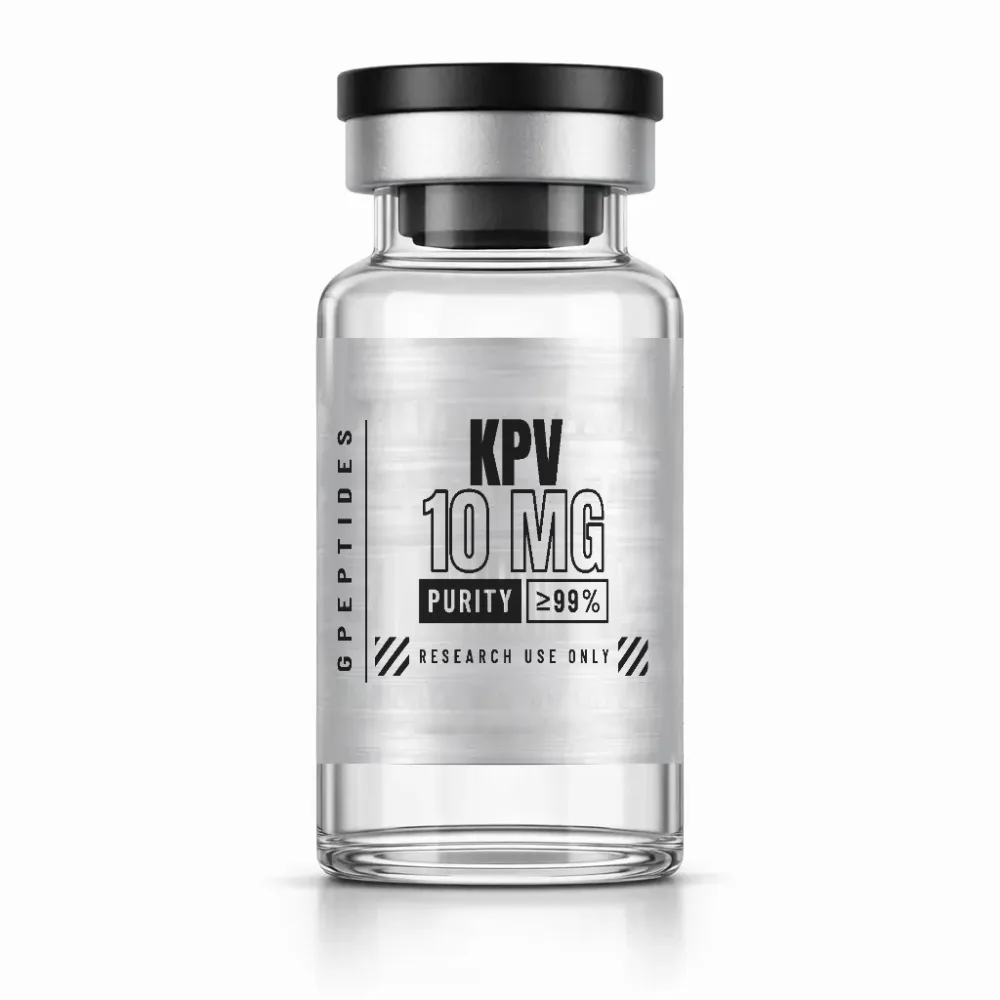
KPV is a synthetic tripeptide of lysine, proline and valine studied in research on regeneration and barrier pathways.
incl. VAT, plus shipping
KPV is supplied as a lyophilised powder in a sealed vial. The product is intended exclusively for laboratory and research purposes and not for use in humans or animals.
The available test documents are kept in the lab section, so product and test report stay linked and traceable.
KPV is a tripeptide of L-lysine, L-proline and L-valine; the name is made up of the one-letter codes of these three amino acids. The sequence forms the C-terminal end of α-melanocyte-stimulating hormone (α-MSH), which is derived from the precursor protein pro-opiomelanocortin (POMC), and corresponds to positions 11 to 13 there. In the literature KPV is therefore also referred to as α-MSH (11–13) or α-melanotropin (11–13). The same motif occurs at positions 11 to 13 of ACTH, so the name ACTH (11–13) is in use as well.
These database values describe KPV as the free acid with unmodified chain ends. In native α-MSH, with the sequence SYSMEHFRWGKPV, the ends are modified: the serine at position 1 is acetylated and the valine at position 13 is amidated. When searching PubChem, look for CID 125672, because a plain name search for “KPV” leads to an unrelated compound.
Among the α-MSH-related products in the range, KPV is the shortest. MT1 (Melanotan I) and MT2 (Melanotan II) are synthetic α-MSH analogues with a longer, deliberately modified sequence and are listed in the Melanocortins & Copper Peptides category. KPV, by contrast, takes three amino acids unchanged from the natural sequence. As a section of a larger molecule, it is therefore classified in the Peptide Fragments category, together with BPC-157 and TB-500.
As a tripeptide, KPV is a substrate of the di- and tripeptide transporter PepT1 (gene SLC15A1). The literature describes uptake via this transporter into intestinal epithelial cells and immune cells. KPV is studied mainly in research on the signalling pathways around NF-κB and MAP kinases. The models used include intestinal epithelial cell lines such as Caco2-BBE and HT29-Cl.19A, the T-cell line Jurkat and preclinical mouse models focusing on the gut. KPV is also discussed as an α-MSH fragment in the context of melanocortin research.
For the free acid, mass spectrometry is expected to show the singly protonated ion at about m/z 343.2, derived from the monoisotopic mass of 342.23 Da. A C-terminally amidated variant, as found in native α-MSH, would be just under 1 Da lighter and could thus be distinguished from the free acid. HPLC complements this identity information with the purity value.
KPV, too, is regularly tested externally by an independent laboratory using HPLC and mass spectrometry. The available certificates of analysis are filed in the lab area; products without a published certificate appear there with the status “pending”. What such a document contains is described in the guide How to read a certificate of analysis.
The relevant product data is part of the page content: form, purity, test method and intended use.
| Form | Lyophilized powder |
|---|---|
| Database | PubChem |
| Purity | ≥98% |
| Test methods | HPLC / MS |
| Unit | 10 mg |
| Category | Peptide Fragments |
| SKU | GP-0018 |
Research Use Only. All products are intended exclusively for scientific in-vitro research and not for human or animal use.
| Use | Research only (in-vitro) |
|---|---|
| Storage | Dry & cool · −20 °C long-term |
Quality assurance
Identity and purity are regularly tested externally by HPLC and mass spectrometry. The available certificates of analysis are filed in the lab section.
View all lab certificates →Current report
The certificate for this product will be published in the lab section as soon as it is available.
View all lab certificates →KPV is made up of the one-letter codes of the three amino acids: K for lysine, P for proline and V for valine. The order follows the sequence from the N- to the C-terminus.
KPV corresponds to positions 11 to 13 and thus to the C-terminal end of α-MSH. Unlike in the native hormone, the valine in the database entry for KPV is not amidated.
A plain name search assigns the abbreviation to an unrelated compound. The tripeptide Lys-Pro-Val is registered under CID 125672 and CAS number 67727-97-3.
PepT1 (SLC15A1) is a membrane transporter for di- and tripeptides. The literature describes KPV as a substrate of this transporter, which is why PepT1 plays a central role in cell models involving KPV.
Exclusively for scientific in-vitro research and laboratory use. Not for human or animal use, not for diagnostic or therapeutic purposes.
As a lyophilized (freeze-dried) powder in a sealed vial. For reconstitution in a research context, bacteriostatic water is typically used.
Unopened and lyophilized: cool, dry and protected from light; for long-term storage at −20 °C. Reconstituted: refrigerated and used promptly.
Published certificates of analysis are listed by product in the Lab section. If no report is available for a product yet, it is marked as “pending” there.
TB-500 denotes the N-terminally acetylated heptapeptide Ac-LKKTETQ from thymosin β4. This guide explains the naming, the structure and the distinction from related molecules, as well as the analytics and storage of the laboratory reagent.
Read more: TB-500: structure, analytics and handling in research →MT1 and MT2 are two structurally distinct analogues of α-MSH: a linear chain of 13 residues and a heptapeptide closed by a lactam bridge. This guide explains the naming, structure, expected masses, typical by-products and storage of the lyophilisates.
Read more: Melanotan I and II: structure, analytics and handling in research →In GHK-Cu, the unmodified tripeptide Gly-His-Lys binds a copper(II) ion. This guide explains the naming, the copper binding, the distinction from related molecules, the expected masses in the certificate of analysis, and the storage and handling of the reagent.
Read more: GHK-Cu: structure, analytics and handling in research →