Guides
BPC-157: structure, analytics and handling in research
BPC-157 is a synthetic pentadecapeptide without end-group modification whose sequence is traced back to a gastric juice protein described in the literature. This guide explains the naming, structure, distinction from related fragments, analytics and storage of the reagent.
Research Use Only- Published2026-09-24
- Updated2026-09-24
- AuthorGPeptides editorial team (operator)
Overview and naming
BPC-157 is the established short name for a synthetic peptide of 15 amino acids. The letters go back to the historical literature name “Body Protection Compound”; the name is a designation, not a statement about any property of the reagent. The number 157 is likewise simply part of the name and indicates neither chain length nor mass. Spellings such as BPC 157 or BPC157 refer to the same pentadecapeptide.
In the GPeptides catalogue the name appears in two products:
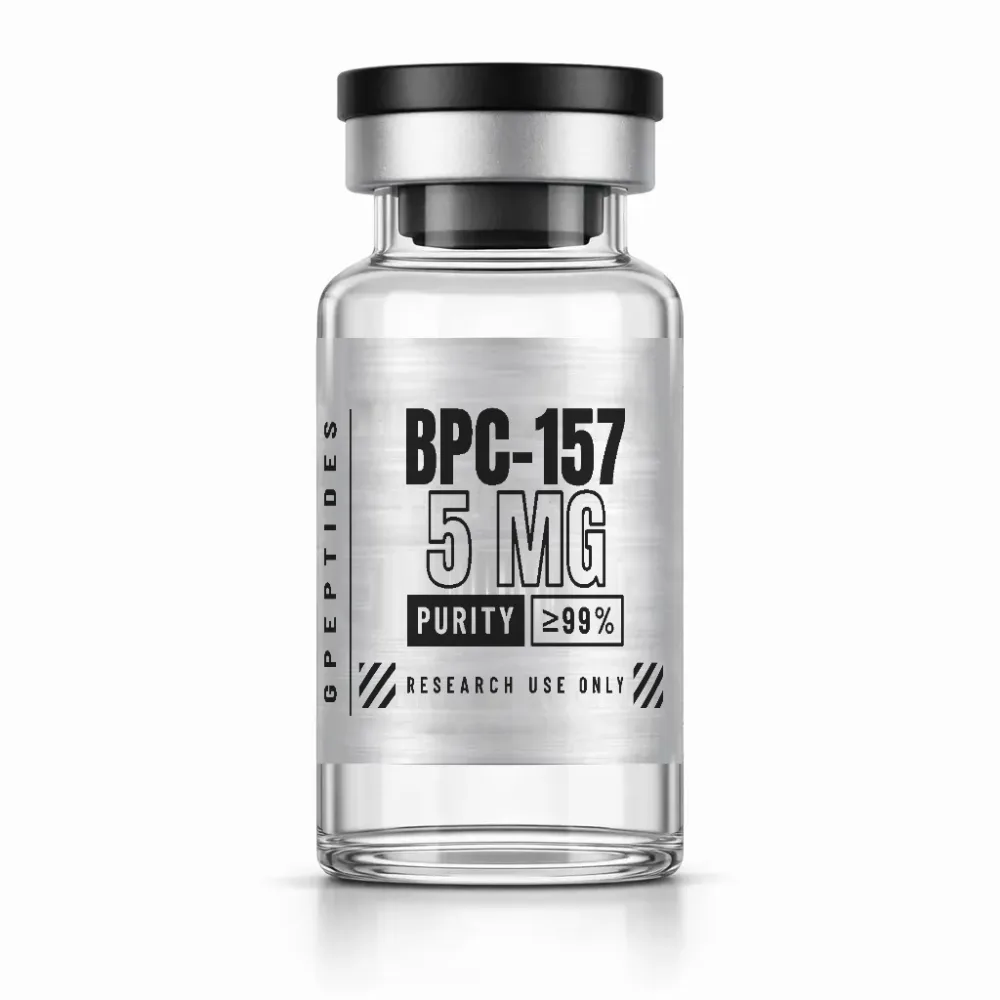
- BPC-157: the single peptide as a lyophilisate, 5 mg per vial.
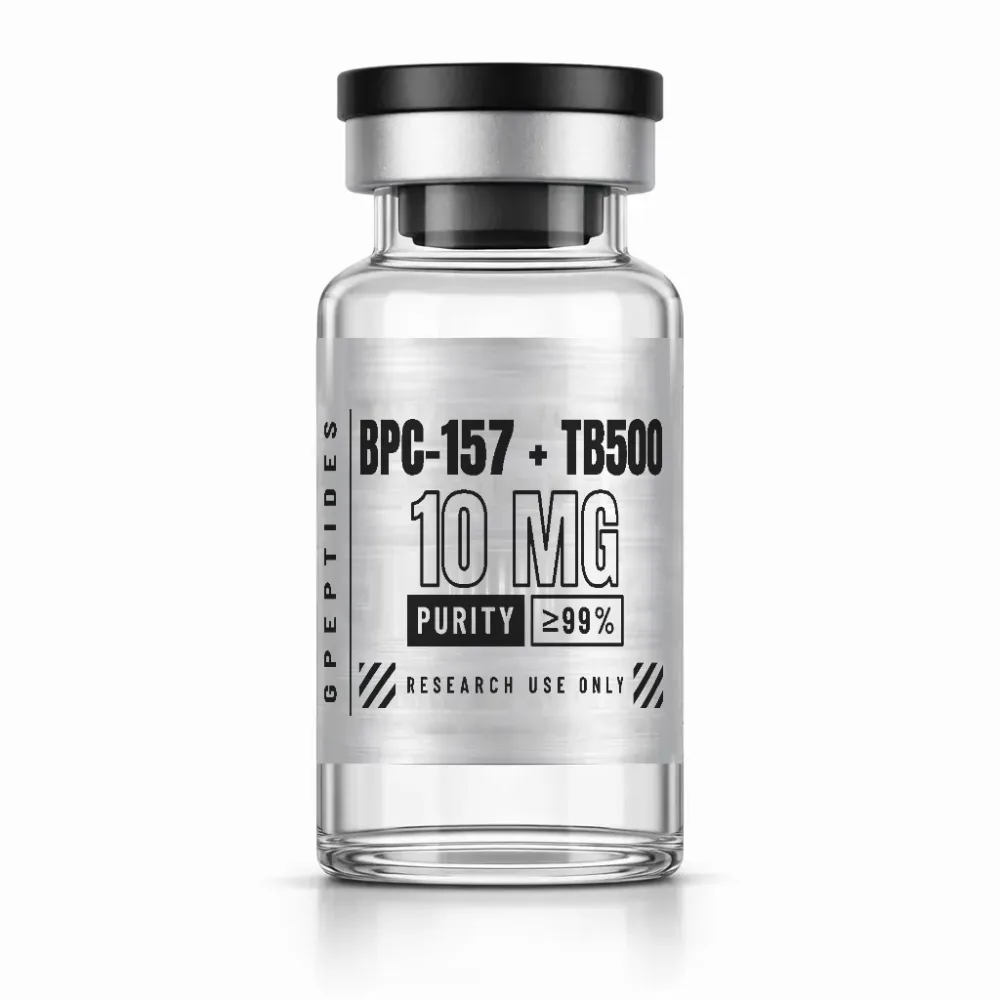
- BPC-157 + TB500: a blend in which BPC-157 and the thymosin β4 fragment TB-500 are filled together; the stated 10 mg covers both peptides.
What establishes identity is not the trade name but the combination of sequence, CAS number 137525-51-0 and the mass-spectrometric findings.
Structure in detail
The sequence GEPPPGKPADDAGLV can be divided into three sections:
- Positions 1–8 (GEPPPGKP): a proline-rich region. The side-chain ring of proline, which is bonded to the backbone nitrogen, stiffens the chain. Lysine at position 7 provides the only basic side chain.
- Positions 9–12 (ADDA): two adjacent aspartates flanked by alanine; the most sensitive section for analytics and storage.
- Positions 13–15 (GLV): a short, comparatively hydrophobic end.
By calculation, the molecule carries a net charge of about −2 at neutral pH; the isoelectric point lies in the acidic range. What is missing is just as revealing: BPC-157 is neither acetylated nor amidated, not cyclised, and contains no disulfide bridge, lipid chain or metal complex. An N-terminally acetylated variant would be 42.01 Da heavier, a C-terminally amidated one 0.98 Da lighter; both could be told apart by mass spectrometry. Also absent are methionine, cysteine and tryptophan, the classic oxidation-sensitive side chains, as well as asparagine and glutamine, which are prone to deamidation.
Distinction from related fragments
Compared with the other fragments in the category and with the parent protein of TB-500, there are clear differences in length, end groups and origin:
- BPC-157: 15 amino acids, free termini, C62H98N16O22, 1419.5 g/mol; sequence assigned to a protein described in gastric juice.
- TB-500: 7 amino acids (Ac-LKKTETQ), N-terminally acetylated, C38H68N10O14, 889.0 g/mol; section 17–23 of thymosin β4.
- Thymosin β4: the complete parent protein with 43 amino acids and around 4963 g/mol; not to be equated with TB-500.
- KPV: the tripeptide Lys-Pro-Val with free termini, 342.4 g/mol; section 11–13 of α-MSH.
All they have in common is their origin as a partial sequence of a larger protein; they are not related in sequence.
What to look for in analytics and the COA
The reference point is the monoisotopic mass of the free peptide, 1418.70 Da; where a certificate gives a deconvoluted mass, it may, depending on the instrument, also state the average mass of around 1419.5 Da. With electrospray ionisation, the following are plausible:
- Protonated ions: [M+H]+ at m/z 1419.71 and [M+2H]2+ at m/z 710.36.
- Adducts: [M+Na]+ at m/z 1441.69 and [M+K]+ at m/z 1457.67. They form during ionisation and are not impurities.
- Deletion sequences: synthesis variants lacking one amino acid; around 97 Da lighter without a proline, around 57 Da lighter without a glycine.
- Aspartimide and isoaspartate: at the aspartates, a succinimide ring can form with loss of water, recognisable 18 Da below the target mass. If the ring opens, isoaspartate variants of the same mass are formed, which stand out only chromatographically as a secondary peak.
As BPC-157 contains no aromatic amino acid, it shows practically no absorbance at 280 nm; purity is determined via the peptide bond at 210 to 220 nm. The four bonds preceding proline can cause broadened peaks or shoulders through slow cis-trans isomerisation; whether a secondary signal is an isomer or a foreign substance can only be settled by coupled LC-MS.
Counter-ions associate with the two basic groups, the N-terminus and the lysine. By calculation, two trifluoroacetate ions raise the formula mass by around 228 g/mol, two acetate ions by around 120 g/mol. Chromatographic purity is unaffected, while the net peptide content falls. For the blend, two main peaks are expected; for the TB-500 heptapeptide, for example, [M+H]+ at m/z 889.50. Because the two peptides differ in the number of peptide bonds per milligram, the ratio of the peak areas does not correspond directly to the ratio of their amounts.
Both products are regularly tested externally by HPLC and mass spectrometry. The available certificates of analysis (COA) are published in the lab area; as long as none is available for a product, it is marked there as “pending”. Background is provided in the guides HPLC and mass spectrometry and Purity of research peptides.
Storage and handling in the laboratory
The lyophilisate should be stored dry, protected from light and cool, and at −20 °C or colder for longer periods. Since oxidation and deamidation play hardly any role for this sequence, moisture and heat are the decisive factors: both accelerate hydrolysis and rearrangements at the aspartates. A chilled vial should be allowed to reach room temperature while still closed before you open it, so that no condensation forms. In solution, the degradation pathways mentioned proceed considerably faster; repeated freezing and thawing should be avoided. In the blend, TB-500 with its C-terminal glutamine also contributes a side chain that can slowly deamidate in solution (+0.98 Da). General information is given in the guide Storing lyophilised peptides.
Research context
Unlike hormone analogues, BPC-157 has no known receptor so far around which a series of experiments could be designed. It is studied in in-vitro systems, such as fibroblast cultures, and in preclinical models, predominantly with regard to signalling pathways of cell migration and angiogenesis.
Research use only: legal notice
GPeptides places BPC-157 and the blend on the market exclusively as laboratory reagents for in-vitro research. They are not intended for use in or on the human or animal body and are not offered as medicinal products. GPeptides makes no statements on use or effects; the analytics demonstrate only the identity and purity of the reagent. You will find prices on the product pages BPC-157 and BPC-157 + TB500, and related peptides in the Peptide Fragments category.
Related categories: Peptide Fragments
Related products
Related guides
HPLC and mass spectrometry: basics of peptide analytics
Two methods, two questions: HPLC answers “how pure?”, mass spectrometry “is it the right molecule?”. What lies behind peak, retention time and m/z.
Read more: HPLC and mass spectrometry: basics of peptide analytics →Purity of research peptides: what the percentages mean
Purity is not the same as content. Anyone comparing COAs should be able to distinguish area percent, net peptide content and typical by-products of peptide synthesis.
Read more: Purity of research peptides: what the percentages mean →Storing lyophilised peptides: temperature, light, humidity
Dry, cold, dark: lyophilisates are robust but not indestructible. The key rules for unopened vials, opened vials and solutions.
Read more: Storing lyophilised peptides: temperature, light, humidity →