Guides
TB-500: structure, analytics and handling in research
TB-500 denotes the N-terminally acetylated heptapeptide Ac-LKKTETQ from thymosin β4. This guide explains the naming, the structure and the distinction from related molecules, as well as the analytics and storage of the laboratory reagent.
Research Use Only- Published2026-09-24
- Updated2026-09-24
- AuthorGPeptides editorial team (operator)
Overview: what lies behind the name TB-500
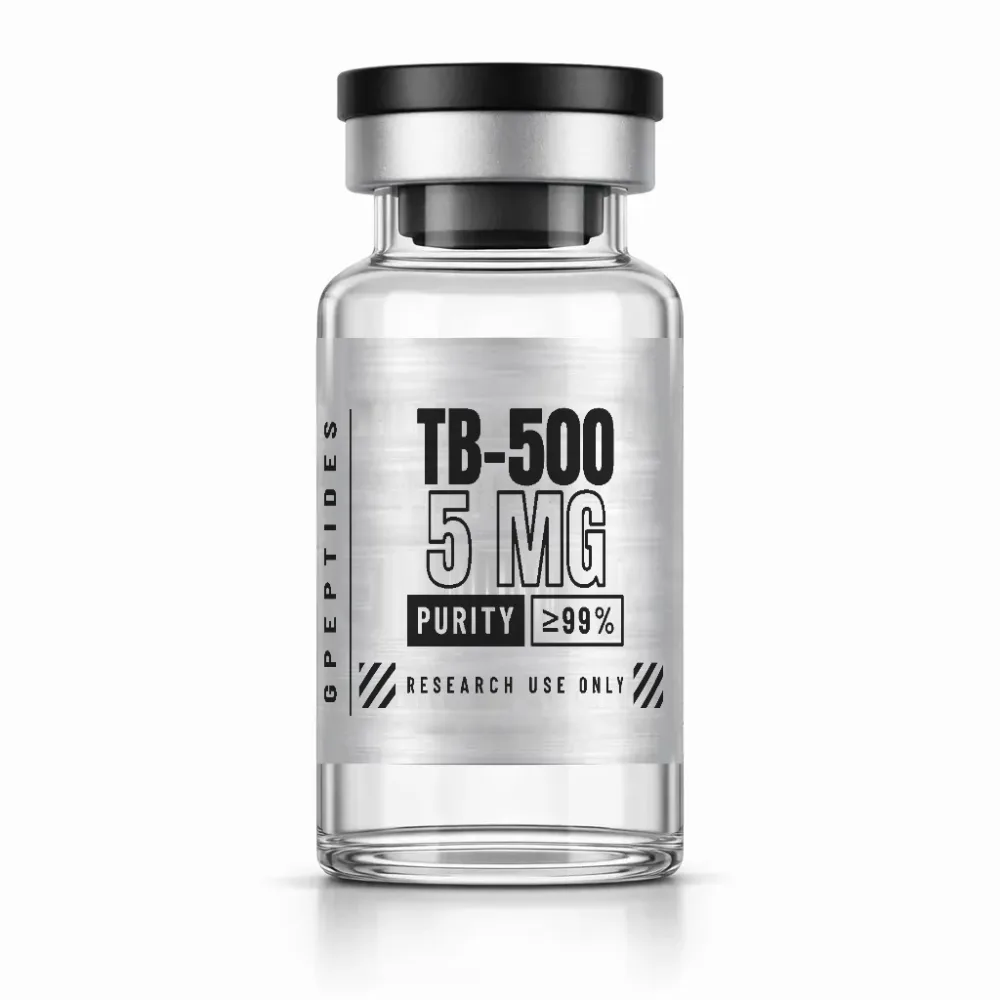
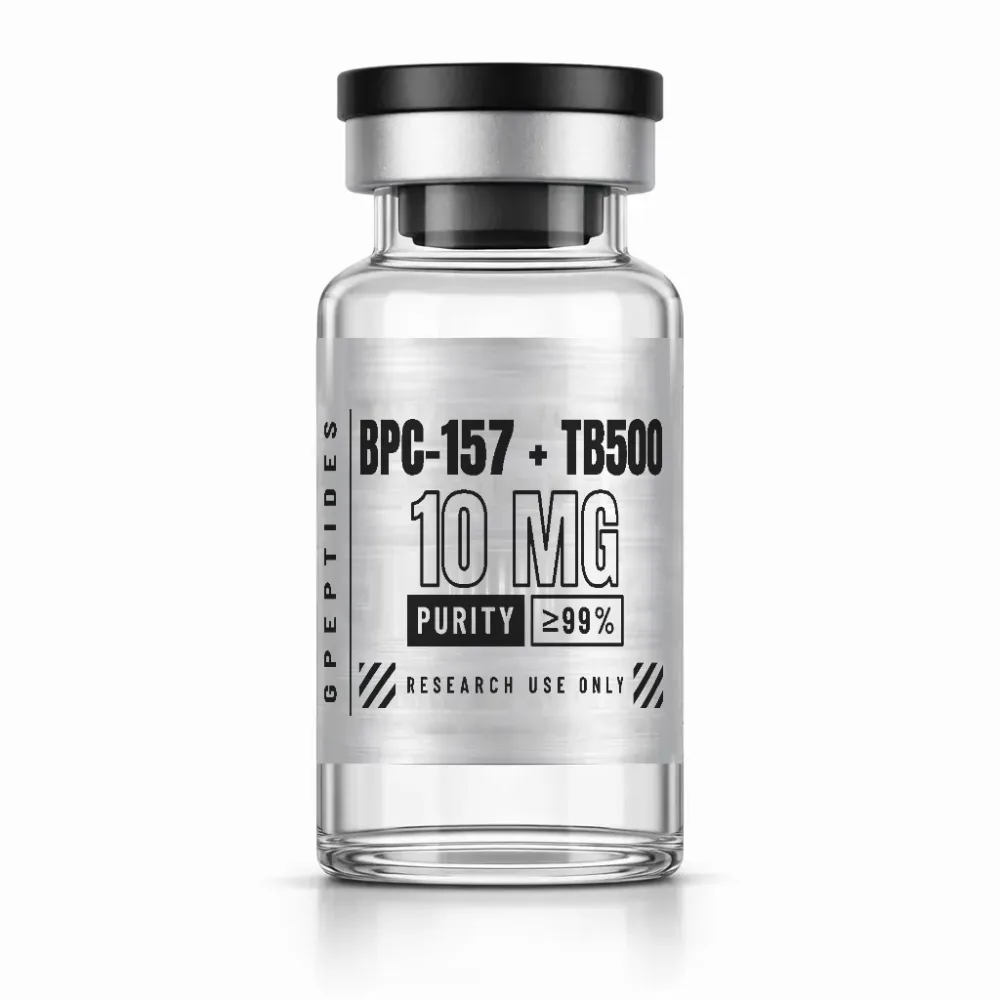
TB-500 is a catalogue and trade name, not an INN and not a systematic name. The “TB” refers to thymosin beta 4, the protein from which the sequence is taken. The number 500, by contrast, is not a chemical specification: it describes neither the chain length nor the mass. The molecule appears twice in the catalogue: as the single product TB-500 with 5 mg and as a component of the blend BPC-157 + TB500 with a total fill weight of 10 mg. What is authoritative for identity is not a name but the sequence, the molecular formula and the mass measured in the certificate.
Structure in detail
The shorthand Ac-LKKTETQ is read from the N- to the C-terminus. “Ac” denotes an acetyl group (CH3CO–) covalently bonded to the amino group of the first residue. It is followed by leucine (L), two lysines (K), threonine (T), glutamic acid (E), threonine again and glutamine (Q); E and Q are easily confused.
The molecular formula is C38H68N10O14, the average molar mass around 889.0 g/mol and the monoisotopic mass 888.49 Da. All residues are in the L-form; as each of the two threonines has two stereocentres, the molecule has nine in total. The peptide is linear, without a disulfide bridge and not cyclised.
The two termini are chemically significant. Acetylation replaces the free, positively charged amino group with a neutral amide bond. The start of the chain thus resembles the peptide bond that exists at this point in the protein and is harder for aminopeptidases to attack. The C-terminus is not amidated; an amidated variant would be only around 0.98 Da lighter and could be reliably told apart only at high resolution. At neutral pH, the two protonated lysine side chains are balanced by two negative charges: the glutamate side chain and the C-terminal carboxyl group.
Distinction from related molecules
- TB-500 (Ac-LKKTETQ-OH): 7 amino acids, C38H68N10O14, around 889 g/mol, CAS 885340-08-9.
- LKKTETQ without the acetyl group: C36H66N10O13, around 847 g/mol; 42 Da lighter and a possible minor component from synthesis.
- Thymosin β4: the complete protein with 43 residues and a molar mass of around 4963 g/mol (CAS 77591-33-4); within it, LKKTETQ forms positions 17 to 23.
- Ac-SDKP: an acetylated tetrapeptide from the N-terminus of the same protein, C20H33N5O9, around 488 g/mol; no sequence overlap with TB-500.
- BPC-157: 15 amino acids, around 1419.5 g/mol, unmodified termini; not related to thymosin β4.
What to look for in analytics and the COA
First check which mass a certificate states: high-resolution instruments measure the monoisotopic mass, while overviews often give the average mass. In the electrospray spectrum of the heptapeptide, the following are typically expected:
- [M+H]+ at m/z 889.50
- [M+2H]2+ at m/z 445.25; the two lysines favour double protonation
- Sodium and potassium adducts at m/z 911.48 and 927.45
Be careful with individual signals: intact thymosin β4 appears as a series of multiply charged ions, for example around m/z 994 (fivefold charged) or 828 (sixfold charged), that is, in the same range. Only the deconvoluted mass is conclusive. Typical minor components are deletion sequences lacking one amino acid (for example minus 128 Da without a lysine, minus 101 Da without a threonine), the non-acetylated peptide (minus 42 Da) and deamidated glutamine. Deamidation shifts the mass by only +0.98 Da, almost coinciding with the first isotope signal; it becomes recognisable at high resolution or as a separate peak in the chromatogram. Epimers, that is, molecules with one amino acid in the D-form, have the same mass and can only be separated chromatographically.
TB-500 contains no aromatic amino acid. In HPLC it is therefore detected via the peptide bonds in the short-wavelength UV range at around 214 to 220 nm; at 280 nm it shows hardly any signal. Purity in area percent must also be distinguished from net peptide content. After purification, the basic lysine side chains are present as a salt, usually with trifluoroacetate (TFA) or acetate as the counter-ion. With two TFA ions per molecule, only around 80 % of the salt mass would be peptide by calculation, with two acetate ions around 88 %, not counting residual water. Do not confuse the two: the acetyl group is covalently bonded and part of the molecular formula, whereas the acetate counter-ion is merely a component of the salt. More on this in the guide Purity of research peptides.
TB-500 is regularly tested externally by HPLC and mass spectrometry. Available certificates of analysis (COA) are published in the lab area; where a certificate is missing, the test is shown there as pending. The measurement methods are explained in the guide HPLC and mass spectrometry, and how to read a certificate in the guide Reading a certificate of analysis.
Storage and handling in the laboratory
The lyophilisate is stored dry, protected from light and cool, and at −20 °C or colder over longer periods. Specific to this molecule: without methionine, cysteine and tryptophan, the classic oxidation sites are absent, and without asparagine and aspartate so are the positions that are particularly prone to deamidation and isomerisation. The most sensitive site is the glutamine; pyroglutamate formation, as seen with N-terminal glutamine, does not occur because it sits at the C-terminus. Moisture remains the most important factor, since peptide salts with acetate or TFA attract water; cold vials should therefore only be opened once they have reached room temperature. In solution, deamidation and hydrolysis proceed considerably faster than in the solid state. More on this in the guide Storing lyophilised peptides.
Research context
In structural biology, LKKTETQ is regarded as the central actin-binding motif of thymosin β4. The synthetic fragment allows this section to be examined in isolation, for example in in-vitro work on the interaction with G-actin and the organisation of the cytoskeleton, and in preclinical cell migration models. No statements about effects in humans or animals are implied.
Research use only: legal notice
GPeptides supplies TB-500 exclusively as a laboratory reagent for in-vitro research. It is not intended for use in or on the human or animal body and is not a medicinal product. GPeptides makes no statements on use or effects; the analytics demonstrate the identity and purity of the reagent, nothing more. You will find price and availability on the product pages TB-500 and BPC-157 + TB500, and further fragments in the Peptide Fragments category.
Related categories: Peptide Fragments
Related products
Related guides
HPLC and mass spectrometry: basics of peptide analytics
Two methods, two questions: HPLC answers “how pure?”, mass spectrometry “is it the right molecule?”. What lies behind peak, retention time and m/z.
Read more: HPLC and mass spectrometry: basics of peptide analytics →How to read a certificate of analysis (COA)
Test method, purity in percent, test date, laboratory: a COA is only as good as the information it contains. How to check whether a certificate matches the vial in your hand.
Read more: How to read a certificate of analysis (COA) →Storing lyophilised peptides: temperature, light, humidity
Dry, cold, dark: lyophilisates are robust but not indestructible. The key rules for unopened vials, opened vials and solutions.
Read more: Storing lyophilised peptides: temperature, light, humidity →