Bestseller
≥98%G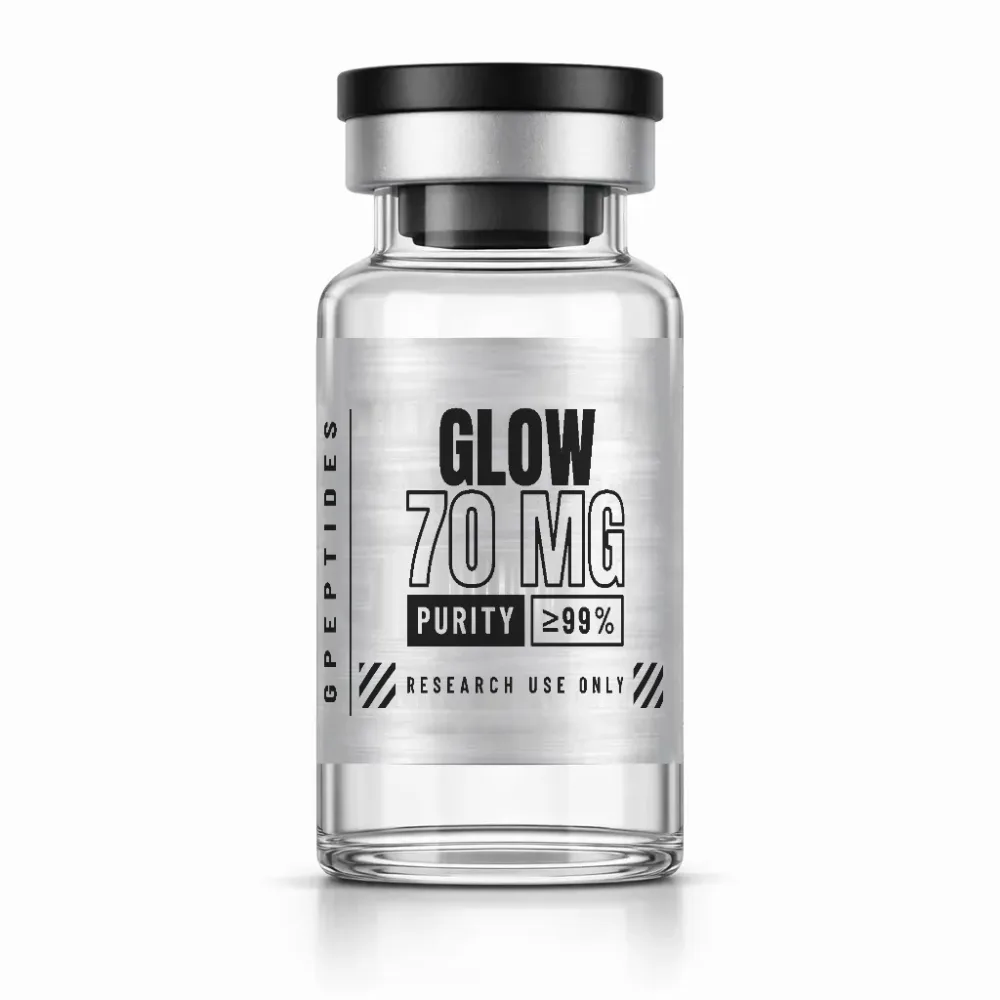
Peptide blend≥98% Purity
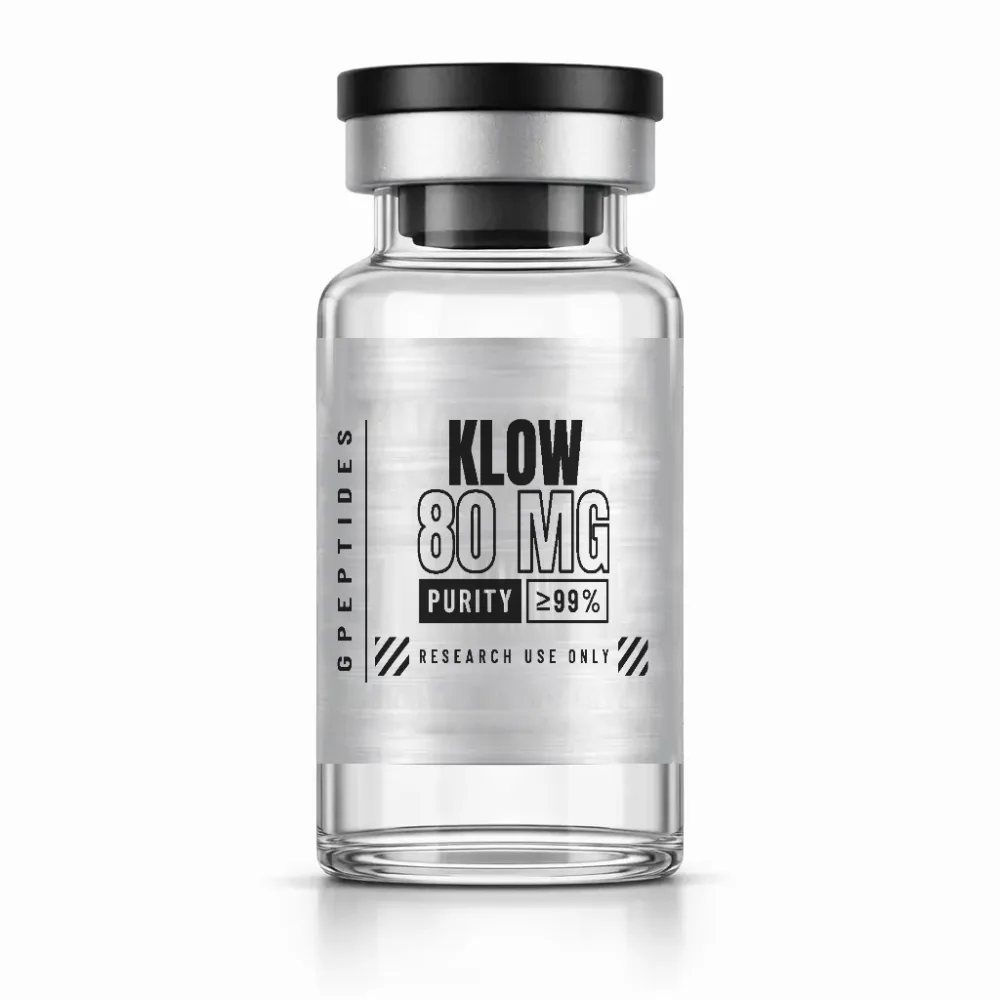
KLOW is a blend of several synthetic compounds for broad regeneration and skin research approaches.
incl. VAT, plus shipping
KLOW is supplied as a lyophilised powder in a sealed vial. The product is intended exclusively for laboratory and research purposes and not for use in humans or animals.
The available test documents are kept in the lab section, so product and test report stay linked and traceable.
Guide · GHK-Cu: structure, analytics and handling in research →
KLOW is a trade name, not a chemical designation. It stands for a peptide blend in which several synthetic peptides from different structural classes are filled together into one vial and freeze-dried. Besides the name, the label states the total fill weight of 80 mg, which covers all components together. The product is occasionally also referred to as “KLOW Blend” or “Klow Stack”. As a mixture, KLOW has no molecular formula, CAS number or PubChem entry of its own; such identifiers exist only for defined single molecules.
In the research-chemical trade, the name KLOW usually denotes a combination of four components that have nothing in common chemically:
What establishes the identity of the peptides in the vial is not the naming convention but the mass-spectrometric evidence in the certificate of analysis.
With the GLOW Stack, the catalogue lists a second blend of this kind. By common trade convention, GLOW comprises the copper peptide together with BPC-157 and TB-500; KLOW adds the α-MSH fragment KPV to this combination. The total fill weight is 70 mg for the GLOW Stack and 80 mg for KLOW. What both have in common is that the ratio of the components is fixed at filling and no single component can be taken out separately. If the peptides are to be examined in separate series of experiments, single vials are the more suitable choice.
We are not aware of any primary publications on KLOW as a mixture in its own right. The components come from separate fields of preclinical research: GHK-Cu from work in cell cultures and animal models on copper-binding peptides and remodelling of the extracellular matrix, BPC-157 and thymosin β4 peptides from work on tissue models and on actin and cell migration, and KPV from in-vitro and animal studies on α-MSH-related inflammatory signalling. Findings on a single substance cannot simply be transferred to the mixture. A blend is therefore suited above all to work in which the combination itself is the subject of investigation.
A four-component blend places greater demands on analytics than a single peptide. In the HPLC chromatogram a separate signal is expected for each component, and additional secondary peaks point to impurities. Mass spectrometry has to find each component again by its mass, which for the usual market composition means BPC-157 at around 1419 Da, KPV at around 342 Da, the tripeptide GHK at around 340 Da or its copper complex, and TB-500, depending on the form, at around 889 Da (heptapeptide) or 4963 Da (complete thymosin β4). Notably, KPV and free GHK are only about 2 Da apart, a gap that a mass spectrometer nevertheless resolves clearly. KLOW is regularly tested externally by an independent laboratory using HPLC and mass spectrometry; available certificates of analysis are in the lab area, and as long as no document has been published for a product, its testing is considered pending.
The relevant product data is part of the page content: form, purity, test method and intended use.
| Form | Lyophilized powder |
|---|---|
| Purity | ≥98% |
| Test methods | HPLC / MS |
| Unit | 80 mg |
| Category | Sets & Bundles |
| SKU | GP-0016 |
Research Use Only. All products are intended exclusively for scientific in-vitro research and not for human or animal use.
| Use | Research only (in-vitro) |
|---|---|
| Storage | Dry & cool · −20 °C long-term |
Quality assurance
Identity and purity are regularly tested externally by HPLC and mass spectrometry. The available certificates of analysis are filed in the lab section.
View all lab certificates →Current report
The certificate for this product will be published in the lab section as soon as it is available.
View all lab certificates →No. The 80 mg on the label is the sum of all components of the blend, not the fill weight of any single component.
In the research-chemical trade, KLOW usually stands for GHK-Cu, BPC-157, TB-500 and KPV in one shared vial. What counts for the actual contents is the mass-spectrometric proof of identity in the certificate of analysis.
Both are blends with several peptides in one vial. By trade convention, KLOW additionally contains the tripeptide KPV; the total fill weight is 80 mg, compared with 70 mg for the GLOW Stack.
No, since all the peptides are present in the same lyophilisate and their ratio is fixed. For separate series of experiments, the catalogue also lists GHK-Cu, BPC-157, TB-500 and KPV as single vials.
Exclusively for scientific in-vitro research and laboratory use. Not for human or animal use, not for diagnostic or therapeutic purposes.
As a lyophilized (freeze-dried) powder in a sealed vial. For reconstitution in a research context, bacteriostatic water is typically used.
Unopened and lyophilized: cool, dry and protected from light; for long-term storage at −20 °C. Reconstituted: refrigerated and used promptly.
Published certificates of analysis are listed by product in the Lab section. If no report is available for a product yet, it is marked as “pending” there.
In GHK-Cu, the unmodified tripeptide Gly-His-Lys binds a copper(II) ion. This guide explains the naming, the copper binding, the distinction from related molecules, the expected masses in the certificate of analysis, and the storage and handling of the reagent.
Read more: GHK-Cu: structure, analytics and handling in research →GLP-3 is a synthetic peptide that addresses the GIP, GLP-1 and glucagon receptors. This guide covers its structure, receptor profile, laboratory testing and storage for in-vitro research.
Read more: GLP-3: triple agonist for in-vitro research →BPC-157 is a synthetic pentadecapeptide without end-group modification whose sequence is traced back to a gastric juice protein described in the literature. This guide explains the naming, structure, distinction from related fragments, analytics and storage of the reagent.
Read more: BPC-157: structure, analytics and handling in research →