- Home
- Shop
- GHRH & GHRP
- Ipamorelin 10 mg
GHRP≥99% Purity
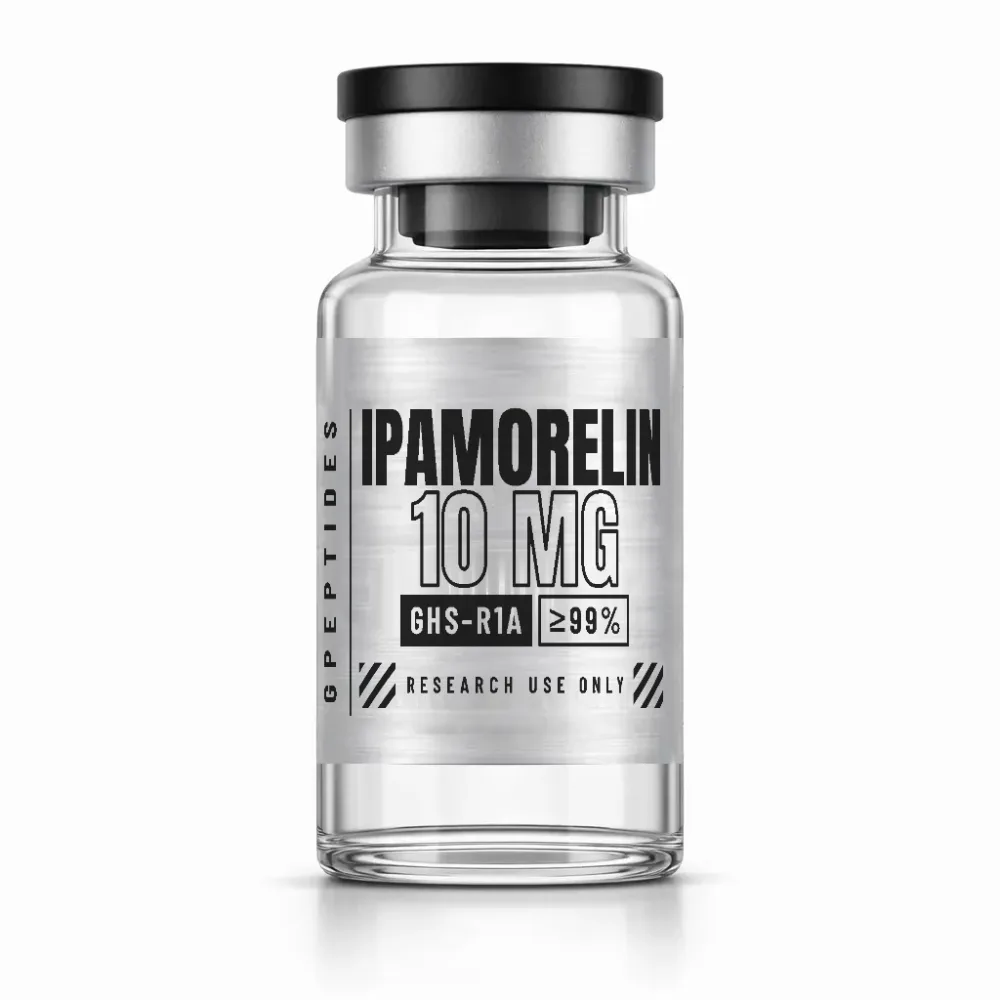
Ipamorelin 10 mg
Ipamorelin is a selective growth-hormone-releasing peptide (GHRP) valued in research for its selectivity.
FormLyophilized powder
AnalyticsHPLC / MS
COALab area
€33.90
incl. VAT, plus shipping
10 mg
Pre-order: delivery may take up to 18 working days. This notice is repeated in the basket and at checkout.
Product information
Ipamorelin is supplied as a lyophilised powder in a sealed vial. The product is intended exclusively for laboratory and research purposes and not for use in humans or animals.
The available test documents are kept in the lab section, so product and test report stay linked and traceable.
Quick profile
- Selective GHRP (pentapeptide)
- Low off-target activity in studies
- ≥99% purity
Guide · CJC-1295 and Ipamorelin: structure, analytics and handling in research →
About Ipamorelin
What is Ipamorelin?
Ipamorelin is a synthetic pentapeptide from the class of growth-hormone-releasing peptides (GHRP). It is described as a ghrelin mimetic and classed as an agonist at the ghrelin receptor, which the literature also calls the GH secretagogue receptor (GHS-R1a). It was identified in a series of compounds that lack the central Ala-Trp dipeptide of GHRP-1. Databases also list the research code NNC 26-0161 and the salt name ipamorelin acetate.
Structure and key data
With five residues, Ipamorelin is the shortest peptide in the GH category. Three of its five building blocks do not occur in this form in natural proteins:
- Sequence: Aib-His-D-2Nal-D-Phe-Lys-NH2
- Aib: 2-aminoisobutyric acid (2-methylalanine) at the N-terminus
- D-2Nal: 3-(2-naphthyl)-D-alanine with an aromatic naphthyl side chain
- D-Phe: D-phenylalanine
- C-terminus: lysinamide
- Molecular formula and mass: C38H49N9O5, 711.9 g/mol (free base)
- CAS number: 170851-70-4, PubChem CID 9831659
Classification: Ipamorelin and related peptides
Research on the GH axis distinguishes between two receptor pathways. GHRH analogues such as CJC-1295 (No DAC) and Tesamorelin are derived from the sequence of growth-hormone-releasing hormone and are assigned to the GHRH receptor. Ipamorelin shares nothing with this sequence and is assigned to the ghrelin receptor, whose endogenous ligand is the peptide ghrelin. The GHRP group also includes GHRP-1, GHRP-2 and GHRP-6, which are not part of the range. The CJC-1295 + Ipamorelin blend brings both peptide families together in a single vial.
Research context
Ipamorelin is studied as a GHS-R1a agonist in research on the secretion of growth hormone from the pituitary. Its initial preclinical characterisation was carried out on primary rat pituitary cells and in animal models. A central question was selectivity: the studies examined to what extent other pituitary hormones such as ACTH are involved in addition to growth hormone. This characterisation places the molecule within the GHRP class and is not a statement about effects.
Analytics at GPeptides
In regular external testing by HPLC and mass spectrometry, such a small molecule gives a readily assignable mass spectrum: the singly protonated ion [M+H]+ is expected at a calculated m/z 712.4 (monoisotopic), and the doubly charged ion may also appear at about m/z 356.7. Deletion sequences lacking one building block are lighter by the mass of that residue and therefore stand out. Stereoisomers are a different matter: a variant with L- instead of D-phenylalanine would have the same mass, so chromatographic separation is more informative here. The available certificates of analysis (COA) are arranged by product in the lab area; without a published certificate, the product is considered “pending”. What to look out for when reading a certificate is explained in the guide to reading a certificate of analysis.
Specifications
The relevant product data is part of the page content: form, purity, test method and intended use.
| Form | Lyophilized powder |
|---|---|
| Database | PubChem |
| Purity | ≥99% |
| Test methods | HPLC / MS |
| Unit | 10 mg |
| Category | GHRH & GHRP |
| SKU | GP-0004 |
Use
Research Use Only. All products are intended exclusively for scientific in-vitro research and not for human or animal use.
| Use | Research only (in-vitro) |
|---|---|
| Storage | Dry & cool · −20 °C long-term |
Lab certificates
Quality assurance
Externally tested, traceably documented.
Identity and purity are regularly tested externally by HPLC and mass spectrometry. The available certificates of analysis are filed in the lab section.
View all lab certificates →Current report
Certificate of Analysis (COA)
The certificate for this product will be published in the lab section as soon as it is available.
View all lab certificates →Frequently asked questions
Which receptor is Ipamorelin assigned to?
Ipamorelin is regarded as an agonist at the ghrelin receptor, also called the GH secretagogue receptor or GHS-R1a. This distinguishes it from GHRH analogues such as CJC-1295 (No DAC) and Tesamorelin, which are assigned to the GHRH receptor.
Which non-proteinogenic building blocks does Ipamorelin contain?
The sequence Aib-His-D-2Nal-D-Phe-Lys-NH2 contains 2-aminoisobutyric acid (Aib), 3-(2-naphthyl)-D-alanine and D-phenylalanine. Only histidine and lysine are present in the natural L-form; the C-terminus is an amide.
Under which other names is Ipamorelin known?
Databases also list Ipamorelin under the research code NNC 26-0161 (NNC-26-0161), as ipamorelin acetate and in the sequence notation Aib-His-D-2-Nal-D-Phe-Lys-NH2. All of these names denote the same pentapeptide with CAS number 170851-70-4.
How does Ipamorelin differ from the CJC-1295 + Ipamorelin blend?
The single product contains only Ipamorelin, with a fill of 10 mg. In the blend, Ipamorelin is present together with the GHRH analogue CJC-1295 in one vial, with a total amount of 10 mg.
What is this product for?
Exclusively for scientific in-vitro research and laboratory use. Not for human or animal use, not for diagnostic or therapeutic purposes.
How is the peptide supplied?
As a lyophilized (freeze-dried) powder in a sealed vial. For reconstitution in a research context, bacteriostatic water is typically used.
How do I store it?
Unopened and lyophilized: cool, dry and protected from light; for long-term storage at −20 °C. Reconstituted: refrigerated and used promptly.
Is there a Certificate of Analysis (COA)?
Published certificates of analysis are listed by product in the Lab section. If no report is available for a product yet, it is marked as “pending” there.
Related products
Related guides
CJC-1295 and Ipamorelin: structure, analytics and handling in research
CJC-1295 (No DAC) and Ipamorelin come from two separate peptide families of the GH axis and are listed in the catalogue both individually and as a blend. This guide explains their naming, chemical modifications, expected masses, typical by-products and how to handle the lyophilisate in the laboratory.
Read more: CJC-1295 and Ipamorelin: structure, analytics and handling in research →GHK-Cu: structure, analytics and handling in research
In GHK-Cu, the unmodified tripeptide Gly-His-Lys binds a copper(II) ion. This guide explains the naming, the copper binding, the distinction from related molecules, the expected masses in the certificate of analysis, and the storage and handling of the reagent.
Read more: GHK-Cu: structure, analytics and handling in research →Semax and Selank: structure, analytics and handling in research
Semax and Selank are linear heptapeptides with the same Pro-Gly-Pro ending, but they differ in origin and charge character. This guide explains their structure, how they differ from related molecules, expected masses, typical by-products and the storage of the lyophilisates.
Read more: Semax and Selank: structure, analytics and handling in research →