Guides
Tesamorelin: structure, analytics and handling in research
Tesamorelin is an N-terminally acylated analogue of human GHRH comprising 44 amino acids. This guide explains its naming, its structure and how it differs from related peptides, as well as the analytics and storage of the laboratory reagent.
Research Use Only- Published2026-09-24
- Updated2026-09-24
- AuthorGPeptides editorial team (operator)
Overview and naming
Tesamorelin is the international non-proprietary name (INN) of a synthetic peptide derived from human growth-hormone-releasing hormone. The parent hormone is also known as GRF or somatoliberin. In connection with Tesamorelin, you will mainly come across these names:
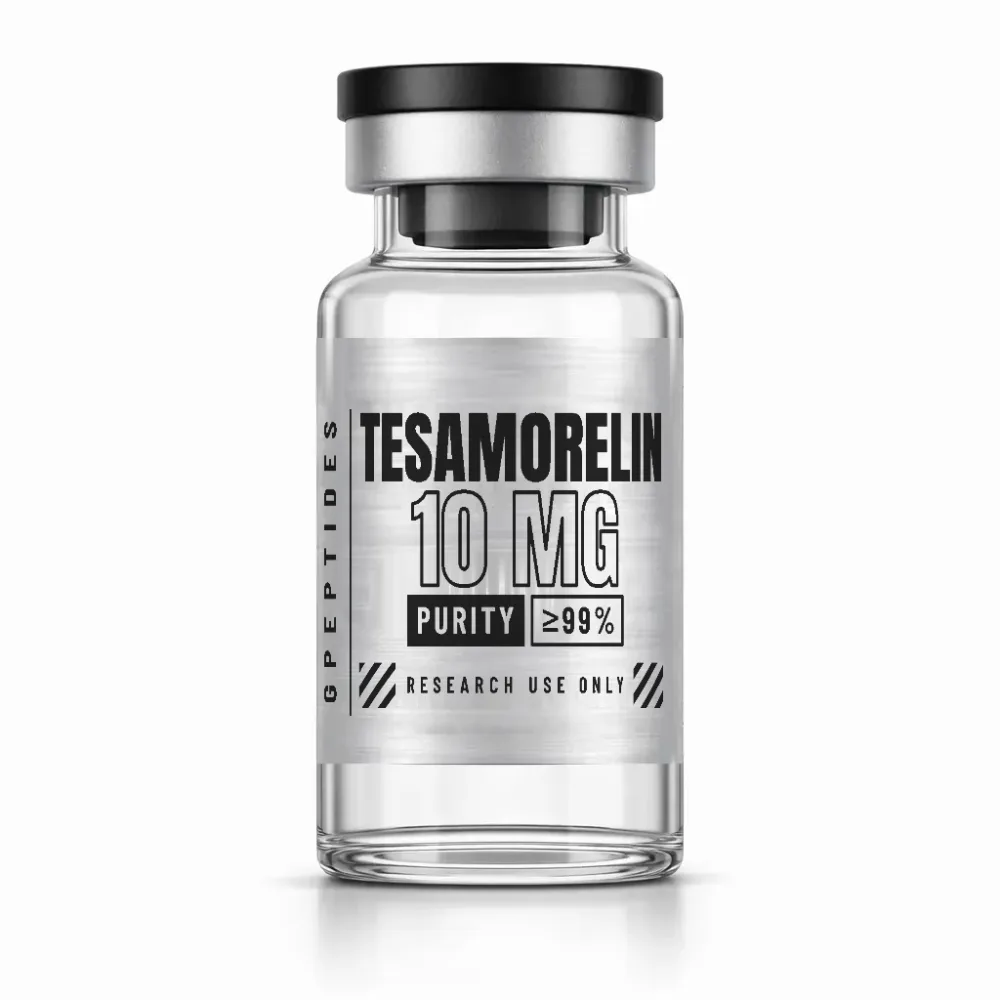
- Tesamorelin: non-proprietary name of the peptide without counter-ion and catalogue name at GPeptides; supplied lyophilised in a vial with a fill weight of 10 mg.
- Tesamorelin acetate: salt form with acetate as the counter-ion.
- TH9507 or TH-9507: an older research code that appears as a synonym in database entries.
- N-[(3E)-hex-3-enoyl]-hGHRH(1-44)-NH2: systematic notation with acyl group, parent sequence and C-terminal amide.
The INN stem ‘-relin’ points to the field of the pituitary releasing hormones but reveals nothing about the receptor family: Ipamorelin carries it too, although it belongs to a different peptide class.
Structure in detail
The backbone consists of 44 L-amino acids in exactly the same order as in the human hormone. All modifications are concentrated at the two chain ends:
- N-terminus: the α-amino group of tyrosine 1 is linked via an amide bond to a trans-3-hexenoyl residue, a C6 acyl group with an E-configured double bond between C3 and C4. The molecule therefore lacks the free, protonatable amino group at the start of the chain.
- Background to the acylation: unmodified GHRH is a substrate of the protease dipeptidyl peptidase 4 (DPP-4), which cleaves between alanine 2 and aspartic acid 3. The acyl group is described as protection against this cleavage; it concerns enzymatic stability, not the sequence.
- C-terminus: as in the natural hormone, the terminal leucine carries a neutral carboxamide group instead of a carboxyl group.
- What is absent: Tesamorelin contains no D-amino acids, no cyclisation, no disulfide bridge and no long-chain lipidation. The basic residues are six arginines and two lysines, the acidic ones two aspartic acids and two glutamic acids.
How it differs from related molecules
The peptides around the GH axis differ in chain length, type of modification and target receptor:
- hGHRH(1-44)-NH2: natural reference sequence with 44 residues, without acyl group; around 5040 Da.
- Tesamorelin: the same 44 residues plus trans-3-hexenoyl at the N-terminus; C221H366N72O67S, around 5136 Da; GHRH receptor.
- hGRF(1-29)-NH2: fragment shortened to the first 29 residues, otherwise unmodified; around 3358 Da.
- CJC-1295 (No DAC): also 29 residues, but with four substitutions, including D-alanine at position 2 and leucine in place of methionine at position 27; around 3368 Da; GHRH receptor.
- Ipamorelin: pentapeptide with non-proteinogenic building blocks, around 712 Da; ghrelin receptor (GHS-R1a) rather than GHRH receptor.
Analytically, mass gives the sharpest distinction: around 1770 Da separate Tesamorelin from the 29-residue analogues, and the roughly 96 Da of the acyl residue separate it from the non-acylated sequence.
What to look for in analytics and the COA
Tesamorelin is regularly tested externally by HPLC and mass spectrometry. The following molecule-specific reference values help when reading a certificate:
- Expected mass: around 5135.9 Da as the average, 5132.7 Da monoisotopic. With electrospray ionisation, several charge states appear side by side; by calculation (based on the average mass), [M+4H]4+ at m/z ≈ 1285.0, [M+5H]5+ at 1028.2 and [M+6H]6+ at 857.0. At around 5 kDa, the monoisotopic signal is not the most intense in the isotope distribution; deviations of 1 Da therefore require a high-resolution measurement.
- Adducts: sodium and potassium adducts shift the deconvoluted mass by approximately +22 and +38 Da respectively. As a rule, they are an effect of ionisation and not a by-product in their own right.
- Typical variant forms: the sulfoxide of methionine 27 (+16 Da, usually eluting slightly earlier in the reversed-phase chromatogram), the form without the acyl group (−96 Da, corresponding to the unmodified sequence), deletion sequences from the synthesis (for example −113 Da for a missing leucine or isoleucine, −156 Da for a missing arginine) and deamidation at asparagine 8 or 35 (around +1 Da). Isomers of identical mass go unnoticed in a simple mass spectrum; here the separation performance of the HPLC is decisive.
- Counter-ions: trifluoroacetate (TFA) frequently originates from synthesis and purification; after a salt exchange, the peptide is present as the acetate. If all eight basic side chains were occupied, around 480 Da would, by calculation, be accounted for by acetate, or around 910 Da by TFA.
- Purity is not peptide content: HPLC purity is the area share of the main peak in the UV chromatogram and captures neither counter-ions nor residual water. Net peptide content, by contrast, refers to the total weight of the material.
Further reading: HPLC and mass spectrometry, How to read a certificate of analysis and Purity and impurities. The available certificates of analysis (COAs) can be found in the lab area; where none has been filed yet, the entry reads ‘pending’.
Storage and handling in the laboratory
Freeze-dried, Tesamorelin is considerably more stable than in solution. In the short term, 2–8 °C is sufficient; for longer periods, −20 °C is recommended, in each case dry and protected from light. Two positions in the sequence deserve particular attention:
- Methionine 27: atmospheric oxygen and light promote oxidation. Therefore keep vials open only briefly.
- Asparagine and glutamine residues: moisture and heat promote deamidation. Let the vial come to room temperature before opening, so that no condensation forms on the powder.
Acetate salts of peptides are often hygroscopic, so weigh quickly and at the lowest possible humidity. It is better to aliquot solutions than to freeze and thaw them repeatedly. General notes are given in the guide Storing lyophilised peptides.
Research context
Tesamorelin is studied in in-vitro and preclinical research on the GHRH receptor, a class B G-protein-coupled receptor that signals via the cAMP pathway. Typical research questions concern receptor binding and signal transduction in receptor-expressing cell systems, as well as the comparison of full-length and truncated GHRH analogues. For peptide chemistry, the molecule is also a model case for N-terminal acylation as protection against exopeptidases such as DPP-4.
Research use only: legal notice
GPeptides places Tesamorelin on the market exclusively as a laboratory reagent for in-vitro research. The product is not intended for use in or on the human or animal body and is not offered as a medicinal product. GPeptides gives no information on use or effects; the analytics confirm the identity and purity of the reagent, nothing more. Price and availability are shown on the product page Tesamorelin, and related peptides in the GHRH & GHRP Peptides category.
Related categories: GHRH & GHRP
Related products
Related guides
HPLC and mass spectrometry: basics of peptide analytics
Two methods, two questions: HPLC answers “how pure?”, mass spectrometry “is it the right molecule?”. What lies behind peak, retention time and m/z.
Read more: HPLC and mass spectrometry: basics of peptide analytics →How to read a certificate of analysis (COA)
Test method, purity in percent, test date, laboratory: a COA is only as good as the information it contains. How to check whether a certificate matches the vial in your hand.
Read more: How to read a certificate of analysis (COA) →Purity of research peptides: what the percentages mean
Purity is not the same as content. Anyone comparing COAs should be able to distinguish area percent, net peptide content and typical by-products of peptide synthesis.
Read more: Purity of research peptides: what the percentages mean →