- Home
- Shop
- GHRH & GHRP
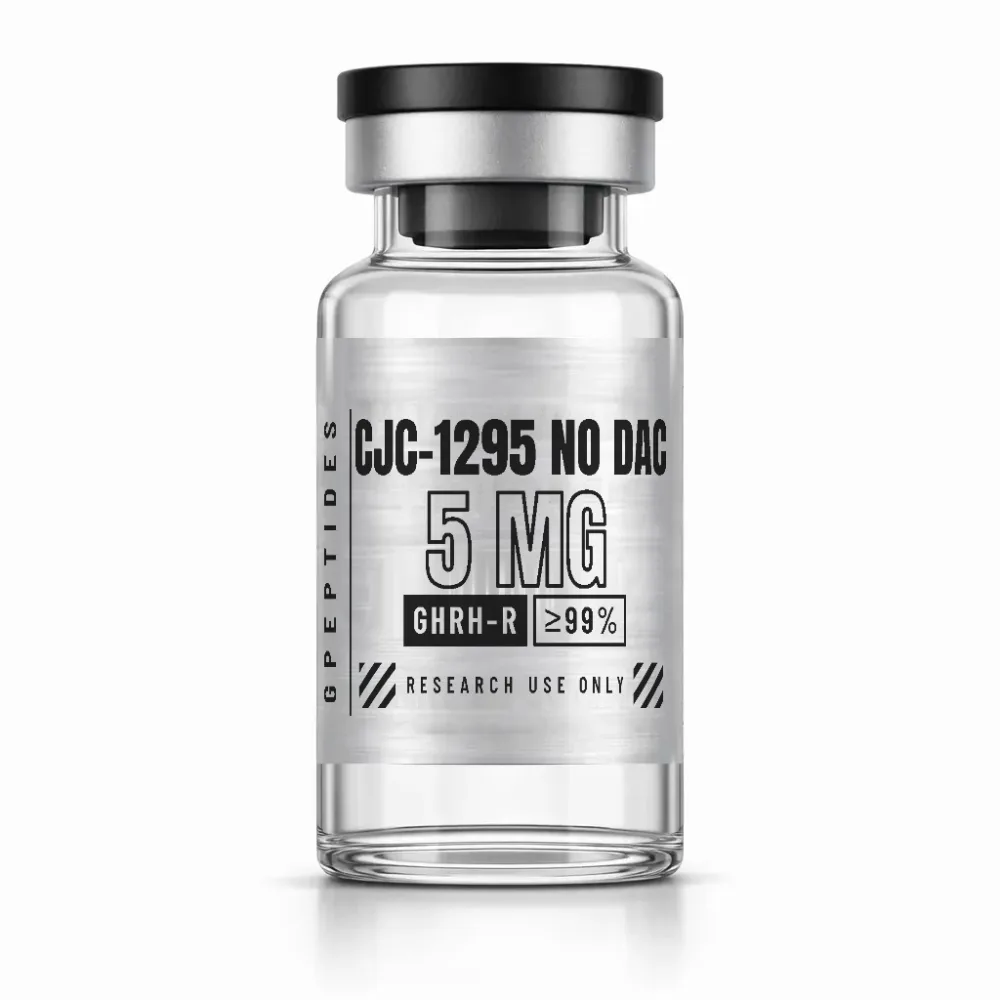
- CJC-1295 (No DAC) 10 mg
GHRH analog≥98% Purity
CJC-1295 (No DAC) 10 mg
CJC-1295 (No DAC), also Mod-GRF(1-29), is a GHRH analog with a shorter half-life for pulsatile research models.
FormLyophilized powder
AnalyticsHPLC / MS
COALab area
€53.90
incl. VAT, plus shipping
10 mg
Product information
CJC-1295 (No DAC) is supplied as a lyophilised powder in a sealed vial. The product is intended exclusively for laboratory and research purposes and not for use in humans or animals.
The available test documents are kept in the lab section, so product and test report stay linked and traceable.
Quick profile
- Modified GRF (1-29)
- Without drug-affinity complex
- GHRH-receptor research
Guide · CJC-1295 and Ipamorelin: structure, analytics and handling in research →
About CJC-1295 (No DAC)
What is CJC-1295 (No DAC)?
CJC-1295 (No DAC) is a truncated analogue of human GHRH: it comprises the first 29 amino acids of the hormone, the fragment GRF(1-29), and substitutes four positions within it. In specialist usage the peptide is therefore also called Modified GRF (1-29), Mod GRF (1-29) for short, or tetrasubstituted hGRF(1-29); the systematic short form is [D-Ala2, Gln8, Ala15, Leu27]-hGRF(1-29)-NH2. Pharmacologically it is classed as an agonist at the GHRH receptor of the pituitary. The suffix “No DAC” is a designation customary in the trade: it distinguishes the peptide from the variant described in the scientific literature under the name CJC-1295, which additionally carries a Drug Affinity Complex (DAC).
Structure and key data
- Sequence (29 amino acids): Y-(D-Ala)-DAIFTQSYRKVLAQLSARKLLQDILSR-NH2
- Substitutions compared with hGRF(1-29): position 2 D-alanine instead of L-alanine, position 8 glutamine instead of asparagine, position 15 alanine instead of glycine, position 27 leucine instead of methionine
- Molecular formula: C152H252N44O42
- Molar mass: 3367.9 g/mol (free peptide)
- PubChem CID: 56841945
With or without DAC: the difference
The DAC variant extends the chain at the C-terminus by an additional lysine whose side chain carries a 3-maleimidopropionamide group that binds to serum albumin. This changes the molecular formula and mass considerably: the DAC form has the formula C165H269N47O46 and 3647.2 g/mol, whereas the peptide without DAC offered here has 3367.9 g/mol. The CAS number 446262-90-4 likewise belongs to the DAC variant and does not describe this product.
Classification: related peptides in the shop
Tesamorelin is also a GHRH analogue but differs in length and in the type of modification: there, the natural chain of 44 residues is retained in full and only the start of the chain carries an additional hexenoyl group; here, the chain is shortened and altered internally. A sequence comparison makes this concrete: where Tesamorelin carries the natural residues alanine, asparagine, glycine and methionine at positions 2, 8, 15 and 27, CJC-1295 (No DAC) has D-alanine, glutamine, alanine and leucine. Ipamorelin belongs to a different family, the GHRP peptides, which are assigned to the ghrelin receptor. The CJC-1295 + Ipamorelin blend contains CJC-1295 and Ipamorelin together in one vial.
Research context
As a modified hGRF(1-29), the peptide is studied in research on the pituitary GH axis and on pulsatile GH secretion, for example in cultured cells of the anterior pituitary and in rodent models.
Analytics at GPeptides
CJC-1295 (No DAC) is regularly tested externally by HPLC and mass spectrometry. Because naming in the trade is inconsistent, mass is the decisive identity criterion: at around 3368 Da the peptide lies about 279 Da below the DAC variant, so any mix-up is immediately apparent in the mass spectrum. With electrospray ionisation it typically appears as a triply or quadruply charged ion, at calculated values of m/z ≈ 1124 and 843 respectively. Because position 27 carries leucine instead of methionine, the sequence contains no sulfur; methionine oxidation can therefore be ruled out as a by-product. Which certificates of analysis (COA) are already available is shown in the lab area; products without a published certificate are marked there as “pending”. The basics of both measurement methods are described in the guide HPLC and mass spectrometry.
Specifications
The relevant product data is part of the page content: form, purity, test method and intended use.
| Form | Lyophilized powder |
|---|---|
| Database | PubChem |
| Purity | ≥98% |
| Test methods | HPLC / MS |
| Unit | 10 mg |
| Category | GHRH & GHRP |
| SKU | GP-0005 |
Use
Research Use Only. All products are intended exclusively for scientific in-vitro research and not for human or animal use.
| Use | Research only (in-vitro) |
|---|---|
| Storage | Dry & cool · −20 °C long-term |
Lab certificates
Quality assurance
Externally tested, traceably documented.
Identity and purity are regularly tested externally by HPLC and mass spectrometry. The available certificates of analysis are filed in the lab section.
View all lab certificates →Current report
Certificate of Analysis (COA)
The certificate for this product will be published in the lab section as soon as it is available.
View all lab certificates →Frequently asked questions
Is CJC-1295 (No DAC) the same as Mod GRF (1-29)?
Yes. Both names denote the tetrasubstituted fragment hGRF(1-29) with D-Ala2, Gln8, Ala15 and Leu27. In the scientific literature, by contrast, the name CJC-1295 refers to the variant with the Drug Affinity Complex.
How do CJC-1295 with and without DAC differ analytically?
The DAC variant carries an additional lysine with a maleimidopropionamide group and, at 3647.2 g/mol, is around 279 Da heavier than the No DAC form at 3367.9 g/mol. The two forms can therefore be told apart unambiguously in the mass spectrum.
Why is no CAS number given for this product?
PubChem holds no unambiguously assigned CAS number for the No DAC form, and numbers circulating in the trade are sometimes used for both variants. The reliable identity criteria are therefore the sequence, the molecular formula and the mass determined by mass spectrometry.
Which positions are altered compared with natural GRF(1-29)?
Four positions: D-alanine at position 2, glutamine instead of asparagine at position 8, alanine instead of glycine at position 15 and leucine instead of methionine at position 27. The remaining 25 residues correspond to the human sequence.
What is this product for?
Exclusively for scientific in-vitro research and laboratory use. Not for human or animal use, not for diagnostic or therapeutic purposes.
How is the peptide supplied?
As a lyophilized (freeze-dried) powder in a sealed vial. For reconstitution in a research context, bacteriostatic water is typically used.
How do I store it?
Unopened and lyophilized: cool, dry and protected from light; for long-term storage at −20 °C. Reconstituted: refrigerated and used promptly.
Is there a Certificate of Analysis (COA)?
Published certificates of analysis are listed by product in the Lab section. If no report is available for a product yet, it is marked as “pending” there.
Related products
Related guides
CJC-1295 and Ipamorelin: structure, analytics and handling in research
CJC-1295 (No DAC) and Ipamorelin come from two separate peptide families of the GH axis and are listed in the catalogue both individually and as a blend. This guide explains their naming, chemical modifications, expected masses, typical by-products and how to handle the lyophilisate in the laboratory.
Read more: CJC-1295 and Ipamorelin: structure, analytics and handling in research →Semax and Selank: structure, analytics and handling in research
Semax and Selank are linear heptapeptides with the same Pro-Gly-Pro ending, but they differ in origin and charge character. This guide explains their structure, how they differ from related molecules, expected masses, typical by-products and the storage of the lyophilisates.
Read more: Semax and Selank: structure, analytics and handling in research →Tesamorelin: structure, analytics and handling in research
Tesamorelin is an N-terminally acylated analogue of human GHRH comprising 44 amino acids. This guide explains its naming, its structure and how it differs from related peptides, as well as the analytics and storage of the laboratory reagent.
Read more: Tesamorelin: structure, analytics and handling in research →