Pre-order
≥99%I
GHRH analog≥98% Purity
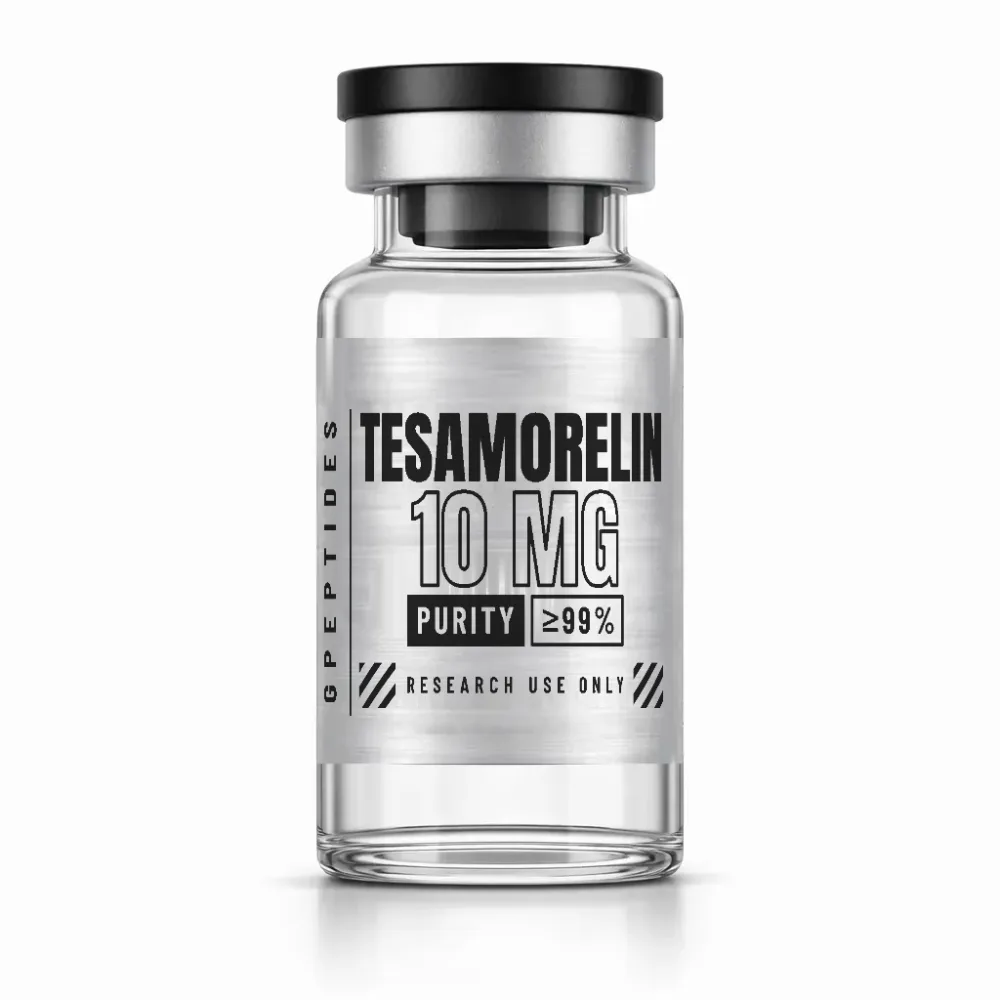
Tesamorelin is a stabilized GHRH analog used in research to regulate the growth-hormone axis.
incl. VAT, plus shipping
Tesamorelin is supplied as a lyophilised powder in a sealed vial. The product is intended exclusively for laboratory and research purposes and not for use in humans or animals.
The available test documents are kept in the lab section, so product and test report stay linked and traceable.
Guide · Tesamorelin: structure, analytics and handling in research →
Tesamorelin is a synthetic analogue of human growth-hormone-releasing hormone (GHRH, also known as somatoliberin or GRF). The peptide comprises all 44 amino acids of the natural sequence and additionally carries a (3E)-hex-3-enoyl group, also called trans-3-hexenoyl, on the N-terminal tyrosine. Pharmacologically it is classed as an agonist at the GHRH receptor (GHRHR), which is located on the somatotroph cells of the anterior pituitary. In databases it also appears under the research code TH9507 and under systematic names such as N-[(3E)-hex-3-enoyl]-hGHRH(1-44)-NH2; tesamorelin acetate denotes the acetate salt form.
The only sulfur atom in the formula comes from the methionine at position 27. Compared with the unmodified sequence hGHRH(1-44)-NH2, the hexenoyl group makes the molecule around 96 Da heavier by calculation.
A comparison with CJC-1295 (No DAC) shows the difference between a full-length and a truncated GHRH analogue: Tesamorelin retains all 44 residues and modifies only the N-terminus, whereas CJC-1295 (No DAC) is shortened to the first 29 amino acids and substitutes four positions within them. The first 29 residues of Tesamorelin, by contrast, are identical to the natural sequence. Ipamorelin is in the same shop category but belongs to the GHRP peptides and is assigned to the ghrelin receptor, not the GHRH receptor. An overview of both families is given in the GHRH & GHRP Peptides category.
Tesamorelin is studied as a GHRH receptor agonist in research on the somatotropic axis, i.e. the regulatory loop formed by growth hormone (GH) and IGF-1. Typical model systems are preclinical models of GH release from the pituitary. Chemically, the molecule is also an example of how a natural peptide sequence can be modified by a small acyl group at the start of the chain without changing the amino-acid sequence itself.
For Tesamorelin, the regular external testing by HPLC and mass spectrometry has two focal points. With 44 residues it is the longest peptide in the GH category, which makes the separation of deletion sequences lacking individual amino acids all the more important. A particular checkpoint is the methionine at position 27: if it oxidises to the sulfoxide, a by-product 16 Da heavier is formed, which can appear as a separate peak in the chromatogram and as a shifted signal in the mass spectrum. For identity testing, the mass is back-calculated from multiply charged ions under electrospray ionisation and compared with the calculated average of around 5136 Da. Which by-products are typical of peptides is described in the guide Purity of research peptides. Available certificates of analysis (COA) can be found in the lab area; those not yet published are marked as “pending”.
The relevant product data is part of the page content: form, purity, test method and intended use.
| Form | Lyophilized powder |
|---|---|
| Database | PubChem |
| Purity | ≥98% |
| Test methods | HPLC / MS |
| Unit | 10 mg |
| Category | GHRH & GHRP |
| SKU | GP-0002 |
Research Use Only. All products are intended exclusively for scientific in-vitro research and not for human or animal use.
| Use | Research only (in-vitro) |
|---|---|
| Storage | Dry & cool · −20 °C long-term |
Quality assurance
Identity and purity are regularly tested externally by HPLC and mass spectrometry. The available certificates of analysis are filed in the lab section.
View all lab certificates →Current report
The certificate for this product will be published in the lab section as soon as it is available.
View all lab certificates →The amino-acid sequence is identical to that of human GHRH(1-44). In addition, there is a trans-3-hexenoyl group on the N-terminal tyrosine, which makes the molecule around 96 Da heavier.
CAS number 218949-48-5 is registered for the free peptide, and PubChem lists it under CID 16137828. The molecular formula is C221H366N72O67S and the molar mass 5135.9 g/mol.
TH9507, also written TH-9507, is a research code under which Tesamorelin is listed as a synonym in databases. It denotes the same molecule.
Methionine is one of the amino acids that are susceptible to oxidation. Tesamorelin contains one methionine residue at position 27; its oxidised form is 16 Da heavier and can be distinguished from the intact peptide by HPLC and mass spectrometry.
Exclusively for scientific in-vitro research and laboratory use. Not for human or animal use, not for diagnostic or therapeutic purposes.
As a lyophilized (freeze-dried) powder in a sealed vial. For reconstitution in a research context, bacteriostatic water is typically used.
Unopened and lyophilized: cool, dry and protected from light; for long-term storage at −20 °C. Reconstituted: refrigerated and used promptly.
Published certificates of analysis are listed by product in the Lab section. If no report is available for a product yet, it is marked as “pending” there.
Tesamorelin is an N-terminally acylated analogue of human GHRH comprising 44 amino acids. This guide explains its naming, its structure and how it differs from related peptides, as well as the analytics and storage of the laboratory reagent.
Read more: Tesamorelin: structure, analytics and handling in research →TB-500 denotes the N-terminally acetylated heptapeptide Ac-LKKTETQ from thymosin β4. This guide explains the naming, the structure and the distinction from related molecules, as well as the analytics and storage of the laboratory reagent.
Read more: TB-500: structure, analytics and handling in research →MT1 and MT2 are two structurally distinct analogues of α-MSH: a linear chain of 13 residues and a heptapeptide closed by a lactam bridge. This guide explains the naming, structure, expected masses, typical by-products and storage of the lyophilisates.
Read more: Melanotan I and II: structure, analytics and handling in research →