Guides
Semax and Selank: structure, analytics and handling in research
Semax and Selank are linear heptapeptides with the same Pro-Gly-Pro ending, but they differ in origin and charge character. This guide explains their structure, how they differ from related molecules, expected masses, typical by-products and the storage of the lyophilisates.
Research Use Only- Published2026-09-24
- Updated2026-09-24
- AuthorGPeptides editorial team (operator)
Overview: two names, two heptapeptides
Semax and Selank are short, linear peptides of seven amino acids each. Both names are trivial names; each molecule is only described unambiguously by its sequence, molecular formula and CAS number. How to read the designations:
- ACTH(4-7)-Pro-Gly-Pro: the numbers in brackets give positions in the parent hormone, here positions 4 to 7 of adrenocorticotropic hormone, followed by the appended partial sequence.
- H- … -OH: shorthand for free chain ends. A prefixed ‘Ac-’ would indicate acetylation, an appended ‘-NH2’ a C-terminal amide.
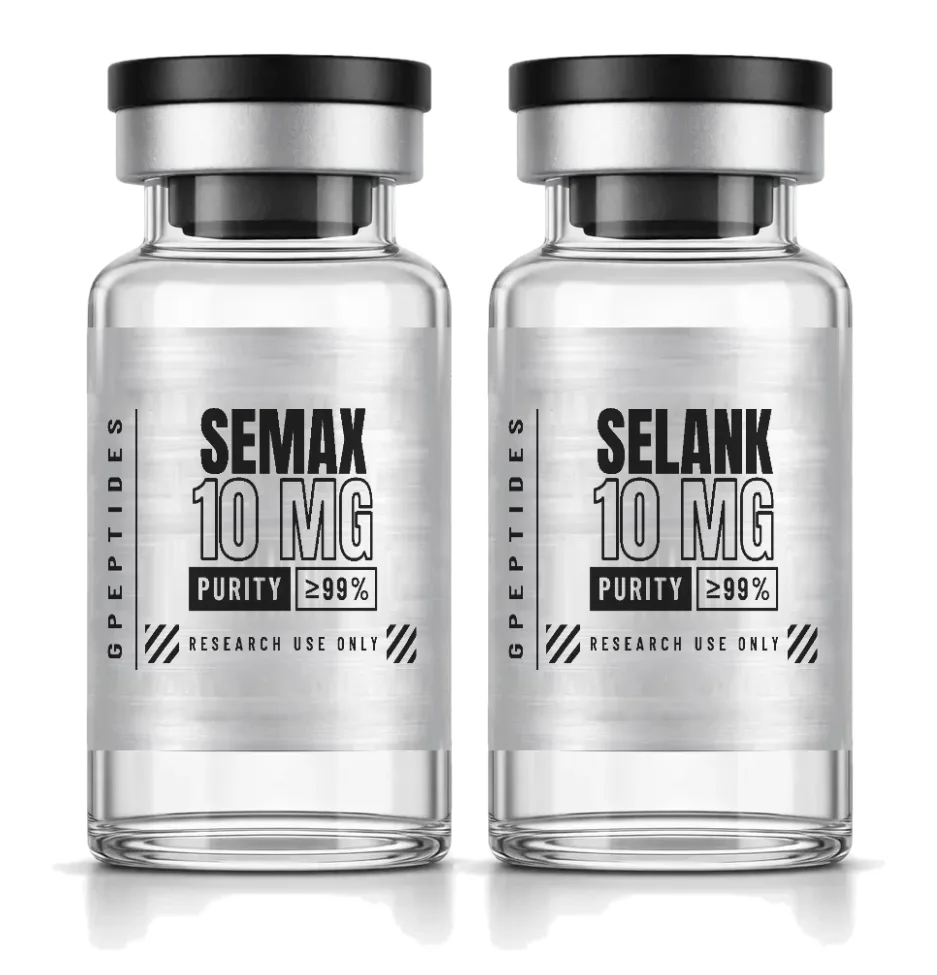
- Semax + Selank: the catalogue name of a set of two separate vials, neither a mixture nor a molecule in its own right.
Structure in detail
Both chains consist of a four-residue head segment of natural origin and the Pro-Gly-Pro ending. Chemically, the head segments differ considerably:
- Semax, H-Met-Glu-His-Phe-Pro-Gly-Pro-OH: methionine carries an oxidation-sensitive thioether, glutamic acid a carboxyl group, histidine an imidazole ring and phenylalanine a hydrophobic aromatic side chain. At neutral pH the molecule carries, by calculation, a slight negative charge.
- Selank, H-Thr-Lys-Pro-Arg-Pro-Gly-Pro-OH: threonine carries a hydroxyl group, lysine a primary amino group and arginine a guanidino group. With the N-terminus, lysine and arginine, Selank has three basic centres; at neutral pH it is clearly positively charged and highly polar.
The Pro-Gly-Pro motif shapes the conformation of the chain end: proline carries no hydrogen atom on its nitrogen, and its ring restricts the rotation of the backbone. Many peptidases cleave bonds at proline only slowly; the literature therefore describes the ending as a stabilising element against enzymatic degradation. There are no further modifications: no cyclisation, no acetylation or amidation, no cysteine and hence no disulfide bridge, no metal complex.
How they differ from related molecules
- ACTH(4-10): natural partial sequence Met-Glu-His-Phe-Arg-Trp-Gly; only the first four residues match Semax.
- α-MSH: contains Met-Glu-His-Phe at positions 4 to 7, but is N-terminally acetylated and C-terminally amidated.
- MT1 and MT2: α-MSH analogues with norleucine instead of methionine; MT2 is additionally closed into a ring via a lactam bridge.
- Tuftsin: Thr-Lys-Pro-Arg, a tetrapeptide of 500.6 g/mol, identical to the first four residues of Selank.
- Acetylated and amidated variants: some catalogues list modified forms such as ‘N-Acetyl Semax Amidate’. Acetylation (+42.01 Da) and amidation (−0.98 Da) together shift the monoisotopic mass by around 41 Da. The peptides from GPeptides have free termini; mass spectrometry distinguishes the two forms unambiguously.
What to look for in analytics and the COA
For identity testing, the monoisotopic masses are what count: 813.35 Da for Semax and 751.43 Da for Selank. With electrospray ionisation in positive mode, the following signals are chiefly to be expected:
- Semax: [M+H]+ at m/z 814.36 and [M+2H]2+ at m/z 407.68; sodium and potassium adducts at m/z 836.34 and 852.31 respectively.
- Selank: [M+H]+ at m/z 752.44, [M+2H]2+ at m/z 376.72 and, favoured by the three basic centres, [M+3H]3+ at m/z 251.49; the sodium adduct lies at m/z 774.42.
Typical by-products differ from one molecule to the other. For Semax, oxidation of the methionine is the most important degradation reaction: the sulfoxide ([M+H]+ at m/z 830.35) is more polar, usually elutes before the main peak in reversed-phase HPLC and occasionally appears as a double peak, because two diastereomers form at the sulfur. For Selank, oxidised variants are hardly to be expected. For both peptides, deletion sequences from the synthesis are possible, for example lacking a proline (−97 Da) or a glycine (−57 Da), and for Selank also residues of the arginine protecting group Pbf (+252 Da). Because of its phenylalanine and methionine, Semax is generally retained more strongly than Selank. As both peptides lack tryptophan and tyrosine, detection is at 210 to 220 nm, not at 280 nm.
Purity in area percent says nothing about net peptide content. For basic peptides the difference is large: if Selank is present as the trifluoroacetate with three counter-ions, just under a third of the mass is, by calculation, accounted for by the counter-ion, and around a fifth as the acetate. For Semax, with the N-terminus and histidine as basic groups, the proportion is smaller. Check, therefore, whether the certificate states the counter-ion and, where applicable, a peptide content.
Semax and Selank are regularly tested externally by HPLC and mass spectrometry. Available certificates of analysis (COAs) can be found in the lab area; where no certificate is shown there, the test is marked as pending. The basics are explained in the guides HPLC and mass spectrometry and Research peptide purity.
Storage and handling in the laboratory
As lyophilisates, both peptides are best stored cold, dry and dark, and at −20 °C for longer periods. Before opening, the vial should reach room temperature so that no condensation gets onto the powder. Specific to each molecule:
- Semax: the methionine reacts with atmospheric oxygen and peroxides. Open the vial only briefly, under inert gas if necessary; in solution, oxidation proceeds considerably faster than in the dry powder.
- Selank: salts of basic peptides readily absorb moisture. Weigh out quickly, close the vial immediately and store it with a desiccant. There are no oxidation-sensitive residues.
Further notes, including on changes in temperature, are given in the guide Storing lyophilised peptides.
Research context
Research on both molecules has so far proceeded without a clearly assigned receptor. In preclinical research, Semax is studied mainly in relation to the neurotrophin system, specifically the gene expression of BDNF and TrkB; individual studies also concern melanocortin receptors. Selank is studied in cell lines and rodent models, with a focus on expression data for GABAergic and inflammation-related genes; in vitro, there are also experiments with enkephalin-degrading enzymes. No conclusions about other systems can be drawn from these models.
Research use only: legal notice
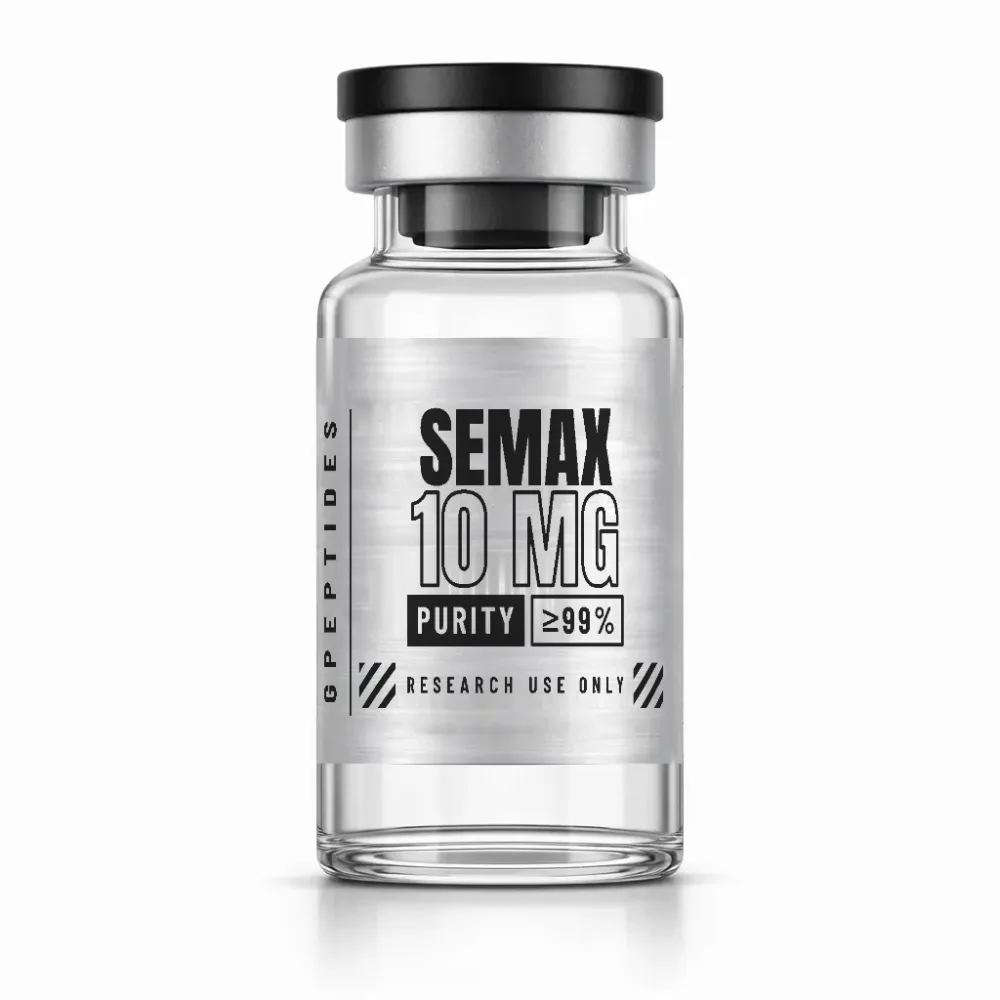
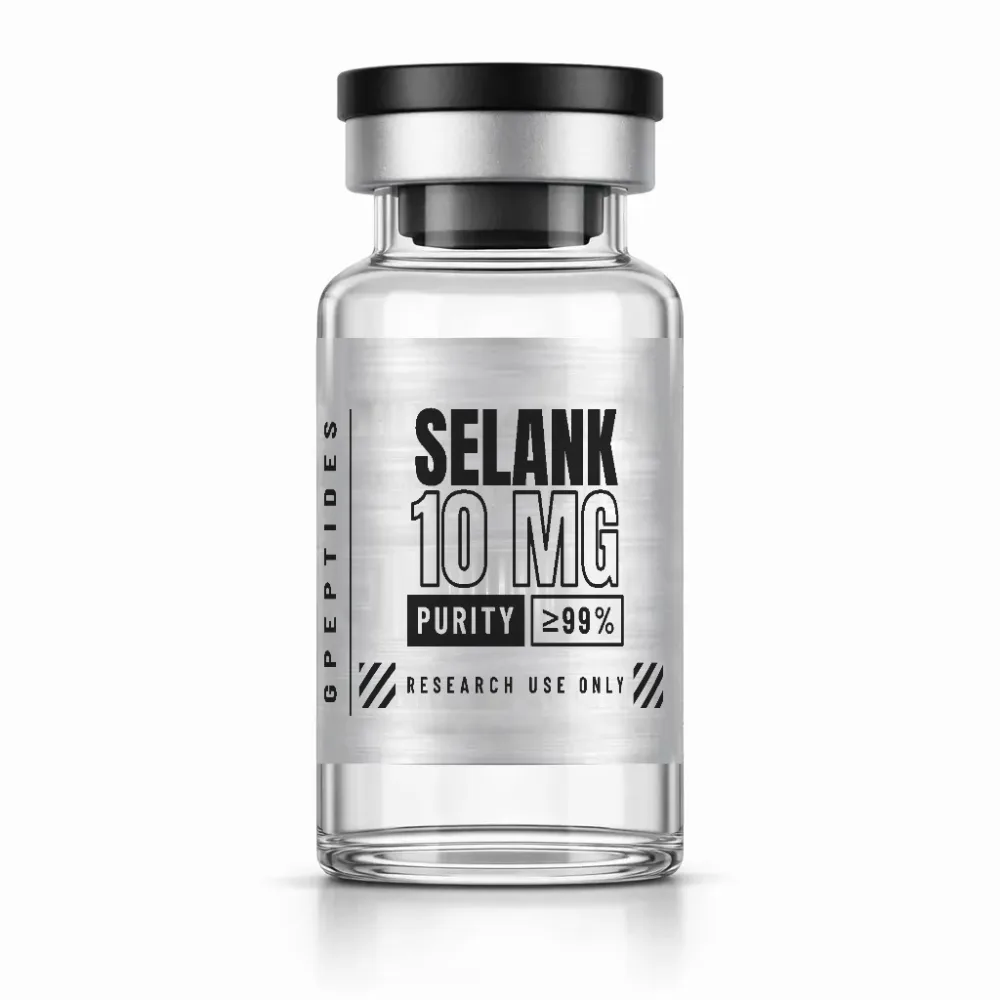
GPeptides places Semax and Selank on the market exclusively as laboratory reagents for in-vitro research; they are not intended for use in or on the human or animal body. GPeptides gives no information on use; the analytics confirm the identity and purity of the reagent. Single vials of 10 mg each are available on the product pages Semax and Selank, and both together in the set Semax + Selank. Further sequences are listed in the Neuropeptides category.
Related categories: Neuropeptides
Related products
Related guides
HPLC and mass spectrometry: basics of peptide analytics
Two methods, two questions: HPLC answers “how pure?”, mass spectrometry “is it the right molecule?”. What lies behind peak, retention time and m/z.
Read more: HPLC and mass spectrometry: basics of peptide analytics →Purity of research peptides: what the percentages mean
Purity is not the same as content. Anyone comparing COAs should be able to distinguish area percent, net peptide content and typical by-products of peptide synthesis.
Read more: Purity of research peptides: what the percentages mean →Storing lyophilised peptides: temperature, light, humidity
Dry, cold, dark: lyophilisates are robust but not indestructible. The key rules for unopened vials, opened vials and solutions.
Read more: Storing lyophilised peptides: temperature, light, humidity →