- Home
- Shop
- Neuropeptides
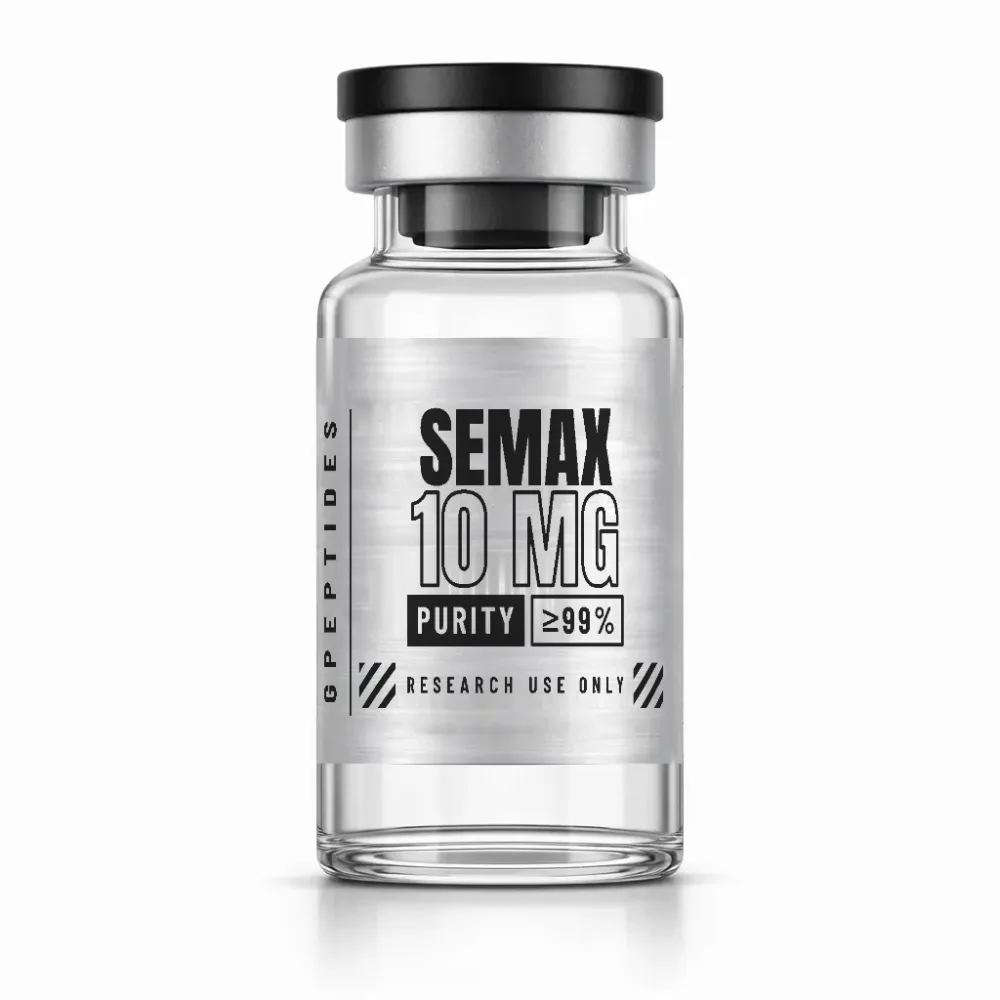
- Semax 10 mg
ACTH(4-10) analog≥98% Purity
Semax 10 mg
Semax is a synthetic heptapeptide studied in research on cognitive and neuroprotective pathways.
FormLyophilized powder
AnalyticsHPLC / MS
COALab area
€29.90
incl. VAT, plus shipping
10 mg
Product information
Semax is supplied as a lyophilised powder in a sealed vial. The product is intended exclusively for laboratory and research purposes and not for use in humans or animals.
The available test documents are kept in the lab section, so product and test report stay linked and traceable.
Quick profile
- Heptapeptide (7 amino acids)
- Nootropic-neuroprotective research
- Lyophilized, ≥98%
Guide · Semax and Selank: structure, analytics and handling in research →
About Semax
What is Semax?
Semax is a synthetic, linear heptapeptide from the sequence family of adrenocorticotropic hormone (ACTH) and thus belongs to the neuropeptide analogues of the melanocortin family. In databases and the scientific literature it also appears as ACTH(4-7)-Pro-Gly-Pro, ACTH(4-7)PGP or, in one-letter notation, MEHFPGP. No single receptor has so far been described in the literature as an established target.
Origin of the sequence
ACTH is a chain of 39 amino acids derived from the precursor protein pro-opiomelanocortin (POMC). Semax takes residues 4 to 7 from it, that is methionine, glutamic acid, histidine and phenylalanine, and extends them at the C-terminus with the tripeptide proline-glycine-proline (PGP). In the catalogue and in many publications Semax is listed as an “ACTH(4-10) analogue”. What is meant is a modified fragment: the ACTH section 4-10 reads Met-Glu-His-Phe-Arg-Trp-Gly, whereas after the phenylalanine Semax continues not with arginine, tryptophan and glycine but with PGP. The structurally exact notation is therefore ACTH(4-7)-Pro-Gly-Pro.
Structure and key data
- Sequence: Met-Glu-His-Phe-Pro-Gly-Pro (MEHFPGP), free N-terminal amine and free C-terminal carboxylic acid
- Molecular formula: C37H51N9O10S
- Molar mass: 813.9 g/mol (calculated)
- CAS number: 80714-61-0
- PubChem CID: 9811102
Formula and mass apply to the free peptide. Counter-ions from synthesis and purification are not included.
Classification: Semax and Selank
Semax is often mentioned in the same breath as Selank, because both heptapeptides were designed on the same principle: a short natural fragment carries the ending Pro-Gly-Pro at its C-terminus. The starting sequences, however, have nothing to do with each other. Semax comes from a section of ACTH whose sequence is also contained in α-MSH; Selank goes back to the tetrapeptide tuftsin. Chemically, this shows for instance in the sulfur atom of methionine, which only Semax has, and in a mass difference of around 62 g/mol. Both peptides are also available together in the Semax + Selank set; the other sequences in this group are listed in the Neuropeptides category.
Research context
The published preclinical work on Semax is based predominantly on rodent and cell culture models. The focus is on gene expression in the neurotrophin system: studies look at the expression of the genes for BDNF (brain-derived neurotrophic factor), its receptor TrkB and NGF in the rat hippocampus and cortex. Further studies evaluate transcriptome and proteome data from brain tissue of experimental animal models. The findings describe these model systems only.
Analytics at GPeptides
Semax is regularly tested by an independent external laboratory. HPLC separates the heptapeptide from synthesis-related by-products such as truncated sequences; the purity value corresponds to the area share of the main peak in the chromatogram. Mass spectrometry confirms identity by comparing the measured mass with the value calculated from C37H51N9O10S. Because Semax contains methionine, a signal 16 Da heavier is informative here: it points to oxidised methionine (methionine sulfoxide). Published certificates of analysis are in the lab area, where products without an available document carry the note “pending”. How separation and mass determination work together is explained in the guide HPLC and mass spectrometry.
Specifications
The relevant product data is part of the page content: form, purity, test method and intended use.
| Form | Lyophilized powder |
|---|---|
| Database | PubChem |
| Purity | ≥98% |
| Test methods | HPLC / MS |
| Unit | 10 mg |
| Category | Neuropeptides |
| SKU | GP-0019 |
Use
Research Use Only. All products are intended exclusively for scientific in-vitro research and not for human or animal use.
| Use | Research only (in-vitro) |
|---|---|
| Storage | Dry & cool · −20 °C long-term |
Lab certificates
Quality assurance
Externally tested, traceably documented.
Identity and purity are regularly tested externally by HPLC and mass spectrometry. The available certificates of analysis are filed in the lab section.
View all lab certificates →Current report
Certificate of Analysis (COA)
The certificate for this product will be published in the lab section as soon as it is available.
View all lab certificates →Frequently asked questions
Why is Semax described as an ACTH(4-10) analogue?
Semax is modelled on the ACTH section 4-10 (Met-Glu-His-Phe-Arg-Trp-Gly): residues 4 to 7 are retained, and Arg-Trp-Gly is replaced by Pro-Gly-Pro. The structurally precise notation is therefore ACTH(4-7)-Pro-Gly-Pro.
What are the molecular formula and molar mass of Semax?
For the free peptide, the molecular formula is C37H51N9O10S and the calculated molar mass is 813.9 g/mol. The CAS number is 80714-61-0.
How do Semax and Selank differ?
Both are heptapeptides with the C-terminal ending Pro-Gly-Pro. Semax is derived from an ACTH fragment and Selank from the tetrapeptide tuftsin, which is why their sequence, molecular formula and mass differ markedly.
Is a target receptor known for Semax?
No single receptor has been reliably assigned so far. Preclinical work focuses mainly on gene expression in the neurotrophin system, for example of BDNF and its receptor TrkB.
What is this product for?
Exclusively for scientific in-vitro research and laboratory use. Not for human or animal use, not for diagnostic or therapeutic purposes.
How is the peptide supplied?
As a lyophilized (freeze-dried) powder in a sealed vial. For reconstitution in a research context, bacteriostatic water is typically used.
How do I store it?
Unopened and lyophilized: cool, dry and protected from light; for long-term storage at −20 °C. Reconstituted: refrigerated and used promptly.
Is there a Certificate of Analysis (COA)?
Published certificates of analysis are listed by product in the Lab section. If no report is available for a product yet, it is marked as “pending” there.
Related products
Related guides
Semax and Selank: structure, analytics and handling in research
Semax and Selank are linear heptapeptides with the same Pro-Gly-Pro ending, but they differ in origin and charge character. This guide explains their structure, how they differ from related molecules, expected masses, typical by-products and the storage of the lyophilisates.
Read more: Semax and Selank: structure, analytics and handling in research →Melanotan I and II: structure, analytics and handling in research
MT1 and MT2 are two structurally distinct analogues of α-MSH: a linear chain of 13 residues and a heptapeptide closed by a lactam bridge. This guide explains the naming, structure, expected masses, typical by-products and storage of the lyophilisates.
Read more: Melanotan I and II: structure, analytics and handling in research →GHK-Cu: structure, analytics and handling in research
In GHK-Cu, the unmodified tripeptide Gly-His-Lys binds a copper(II) ion. This guide explains the naming, the copper binding, the distinction from related molecules, the expected masses in the certificate of analysis, and the storage and handling of the reagent.
Read more: GHK-Cu: structure, analytics and handling in research →