- Home
- Shop
- Neuropeptides
- Selank 10 mg
Tuftsin analog≥98% Purity
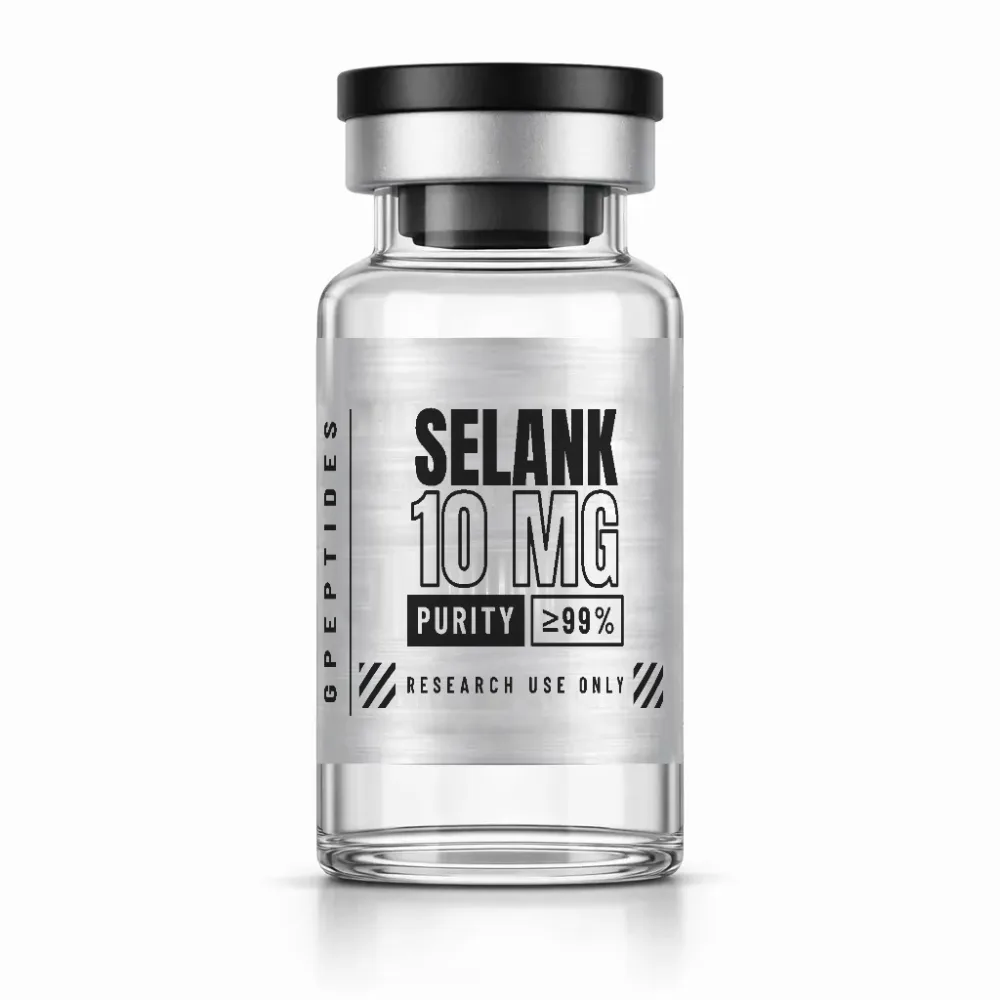
Selank 10 mg
Selank is a synthetic heptapeptide studied in research on neuroregulatory pathways.
FormLyophilized powder
AnalyticsHPLC / MS
COALab area
€29.90
incl. VAT, plus shipping
10 mg
Product information
Selank is supplied as a lyophilised powder in a sealed vial. The product is intended exclusively for laboratory and research purposes and not for use in humans or animals.
The available test documents are kept in the lab section, so product and test report stay linked and traceable.
Quick profile
- Heptapeptide (7 amino acids)
- Neuroregulation research
- Lyophilized, ≥98%
Guide · Semax and Selank: structure, analytics and handling in research →
About Selank
What is Selank?
Selank is a synthetic, linear heptapeptide and an analogue of the tetrapeptide tuftsin. Besides the common name, databases list the code designation TP-7, the spelling variant Selanc and the sequence notations Thr-Lys-Pro-Arg-Pro-Gly-Pro and TKPRPGP. In the catalogue Selank is listed in the neuropeptides group. No single, established target in the sense of a receptor has been identified for the molecule.
From tuftsin to heptapeptide
Tuftsin consists of the four amino acids threonine, lysine, proline and arginine and is a fragment of the heavy chain of immunoglobulin G from the Fc region. The free tetrapeptide has the molecular formula C21H40N8O6 and a molar mass of 500.6 g/mol (CAS 9063-57-4). Selank extends this sequence at the C-terminus by proline, glycine and proline. The first four positions of the heptapeptide chain are thus identical to tuftsin.
Key data for Selank
- Sequence: Thr-Lys-Pro-Arg-Pro-Gly-Pro (TKPRPGP), free N- and C-terminus
- Molecular formula: C33H57N11O9
- Molar mass: 751.9 g/mol (calculated for the free peptide)
- CAS number: 129954-34-3
- PubChem CID: 11765600
Its characteristic features are three proline residues and the basic side chains of lysine and arginine. Selank contains no sulfur-containing or aromatic amino acids.
Classification: Selank, tuftsin and Semax
Selank shares with Semax a chain length of seven amino acids and the appended Pro-Gly-Pro motif. The front part of the sequence, however, has a different origin: in Semax it is a section of the hormone ACTH, in Selank it is tuftsin, which derives from immunoglobulin G. The composition and mass of the two molecules therefore differ so much that they can be reliably told apart analytically. For comparative work both peptides are available in the Semax + Selank set; the Neuropeptides category gives an overview of the group.
Research context
The preclinical literature on Selank comprises studies in rodents and in cell lines such as IMR-32. One focus is the expression of genes involved in GABAergic neurotransmission. These are gene expression data, not evidence of binding to a GABA receptor. Other studies examine the expression of inflammation-related genes such as chemokines and cytokines, measurements of BDNF in rat brain tissue, and in-vitro experiments with enkephalin-degrading enzymes in human plasma.
Analytics at GPeptides
Selank is tested externally at regular intervals, by HPLC for purity and by mass spectrometry for identity, in each case by an independent laboratory. As the peptide has no aromatic amino acids, UV detection in the chromatogram relies on the absorption of the peptide bonds in the short-wavelength range. In the mass spectrum the measured value is compared with the mass calculated from C33H57N11O9; because of the basic residues lysine and arginine, multiply protonated ions also frequently appear in electrospray ionisation. The lab area shows which certificates have already been published; where a document is missing, the entry there is marked “pending”. How purity figures can be put into context is described in the guide Purity of research peptides.
Specifications
The relevant product data is part of the page content: form, purity, test method and intended use.
| Form | Lyophilized powder |
|---|---|
| Database | PubChem |
| Purity | ≥98% |
| Test methods | HPLC / MS |
| Unit | 10 mg |
| Category | Neuropeptides |
| SKU | GP-0020 |
Use
Research Use Only. All products are intended exclusively for scientific in-vitro research and not for human or animal use.
| Use | Research only (in-vitro) |
|---|---|
| Storage | Dry & cool · −20 °C long-term |
Lab certificates
Quality assurance
Externally tested, traceably documented.
Identity and purity are regularly tested externally by HPLC and mass spectrometry. The available certificates of analysis are filed in the lab section.
View all lab certificates →Current report
Certificate of Analysis (COA)
The certificate for this product will be published in the lab section as soon as it is available.
View all lab certificates →Frequently asked questions
What does the designation TP-7 mean?
TP-7 is a code designation for Selank listed in databases. It refers to the same heptapeptide with the sequence Thr-Lys-Pro-Arg-Pro-Gly-Pro.
How are Selank and tuftsin related?
The first four amino acids of Selank correspond to the tetrapeptide tuftsin (Thr-Lys-Pro-Arg), a fragment of the heavy chain of immunoglobulin G. Selank extends this sequence by Pro-Gly-Pro.
What are the key data for Selank?
The free peptide has the molecular formula C33H57N11O9 and a calculated molar mass of 751.9 g/mol. The CAS number is 129954-34-3 and the PubChem CID is 11765600.
Does Selank bind to GABA receptors?
This has not been demonstrated. The GABA-related findings in the preclinical literature are gene expression data from animal models and cell cultures, not evidence of receptor binding.
What is this product for?
Exclusively for scientific in-vitro research and laboratory use. Not for human or animal use, not for diagnostic or therapeutic purposes.
How is the peptide supplied?
As a lyophilized (freeze-dried) powder in a sealed vial. For reconstitution in a research context, bacteriostatic water is typically used.
How do I store it?
Unopened and lyophilized: cool, dry and protected from light; for long-term storage at −20 °C. Reconstituted: refrigerated and used promptly.
Is there a Certificate of Analysis (COA)?
Published certificates of analysis are listed by product in the Lab section. If no report is available for a product yet, it is marked as “pending” there.
Related products
Related guides
Semax and Selank: structure, analytics and handling in research
Semax and Selank are linear heptapeptides with the same Pro-Gly-Pro ending, but they differ in origin and charge character. This guide explains their structure, how they differ from related molecules, expected masses, typical by-products and the storage of the lyophilisates.
Read more: Semax and Selank: structure, analytics and handling in research →GHK-Cu: structure, analytics and handling in research
In GHK-Cu, the unmodified tripeptide Gly-His-Lys binds a copper(II) ion. This guide explains the naming, the copper binding, the distinction from related molecules, the expected masses in the certificate of analysis, and the storage and handling of the reagent.
Read more: GHK-Cu: structure, analytics and handling in research →CJC-1295 and Ipamorelin: structure, analytics and handling in research
CJC-1295 (No DAC) and Ipamorelin come from two separate peptide families of the GH axis and are listed in the catalogue both individually and as a blend. This guide explains their naming, chemical modifications, expected masses, typical by-products and how to handle the lyophilisate in the laboratory.
Read more: CJC-1295 and Ipamorelin: structure, analytics and handling in research →