Bestseller
≥98%G
Mitochondrial peptide≥97% Purity
MOTS-c is a mitochondrially encoded peptide studied in research on metabolism and cellular energy regulation.
incl. VAT, plus shipping
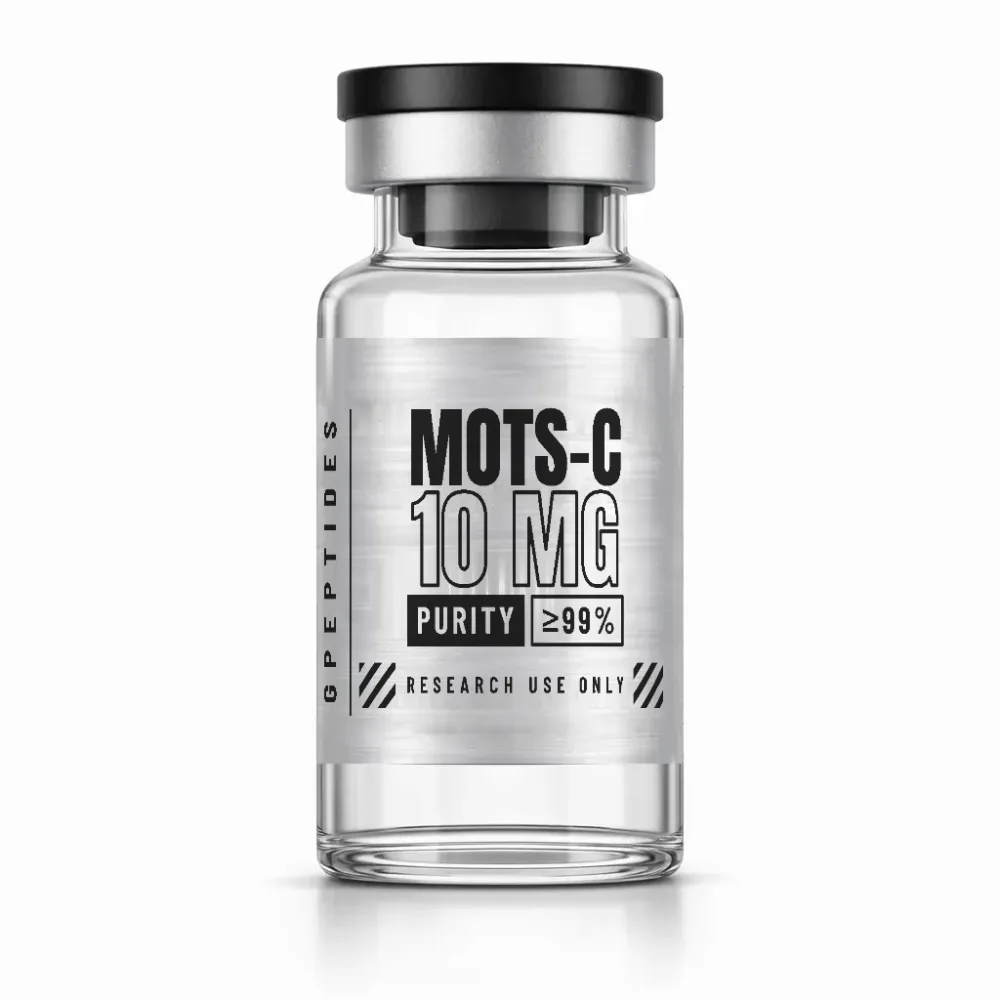
MOTS-c is supplied as a lyophilised powder in a sealed vial. The product is intended exclusively for laboratory and research purposes and not for use in humans or animals.
The available test documents are kept in the lab section, so product and test report stay linked and traceable.
Guide · MOTS-c: structure, analytics and handling in research →
MOTS-c is a peptide of 16 amino acids and belongs to the mitochondria-derived peptides (MDP). The name stands for “mitochondrial open reading frame of the 12S rRNA-c” and describes where the sequence is found: it is encoded in a short open reading frame within the 12S rRNA gene of mitochondrial DNA, not in the cell nucleus. The peptide was first described in 2015. MOTS-c is endogenous; the form offered here is produced synthetically and corresponds to the human sequence.
The C-terminal end is striking: the last four residues include three basic amino acids (Arg, Lys, Arg), and there is also an arginine at position 2. At neutral pH the molecule therefore carries a positive net charge. The two sulfur atoms in the molecular formula come from the methionines at positions 1 and 6.
MOTS-c is currently the only member of the Mitochondrial Peptides category. The literature names humanin as a further mitochondrially encoded peptide; it is not listed in the catalogue. Thematically, MOTS-c touches on metabolic research, to which GLP-3 from the incretin analogues is also assigned; structurally, the two molecules are unrelated. The same applies to Glutathione, a tripeptide from redox research that is likewise not structurally related to MOTS-c.
MOTS-c is studied in cell cultures and rodent models of metabolic homeostasis, with a focus on skeletal muscle tissue. No classical membrane receptor has been identified so far. In the paper that first described the peptide, its cellular activity was linked to inhibition of the folate cycle and the de novo purine biosynthesis coupled to it, which in turn leads to the activation of AMP-activated protein kinase (AMPK). Part of the research accordingly deals with communication between mitochondria and the cell nucleus via folate and AMPK signalling pathways.
MOTS-c is supplied in a 10 mg vial; the listed purity is ≥ 97 % (HPLC). Mass spectrometry compares the measured mass with the value from the molecular formula C101H152N28O22S2, i.e. around 2173.11 Da (monoisotopic) or 2174.6 Da (average mass). Because of the four basic residues, the spectrum shows several charge states, which are combined into the molecular mass by deconvolution. Signals 16 Da above the target mass are revealing: they point to an oxidised methionine, a typical minor component of methionine-containing sequences. The peptide is regularly tested externally by HPLC and mass spectrometry; an independent external laboratory is commissioned to carry it out. The available certificates of analysis (COA) can be found in the lab area; if none is listed there yet for MOTS-c, testing is pending. The testing steps involved are described in the guide Quality control.
The relevant product data is part of the page content: form, purity, test method and intended use.
| Form | Lyophilized powder |
|---|---|
| Database | PubChem |
| Purity | ≥97% |
| Test methods | HPLC / MS |
| Unit | 40 mg |
| Category | Mitochondrial Peptides |
| SKU | GP-0012-1 |
Research Use Only. All products are intended exclusively for scientific in-vitro research and not for human or animal use.
| Use | Research only (in-vitro) |
|---|---|
| Storage | Dry & cool · −20 °C long-term |
Quality assurance
Identity and purity are regularly tested externally by HPLC and mass spectrometry. The available certificates of analysis are filed in the lab section.
View all lab certificates →Current report
The certificate for this product will be published in the lab section as soon as it is available.
View all lab certificates →MOTS-c is the abbreviation for “mitochondrial open reading frame of the 12S rRNA-c”. The name refers to the reading frame in the 12S rRNA gene of mitochondrial DNA in which the sequence is encoded.
No classical membrane receptor has been identified so far. In the original paper, the cellular activity was linked to the folate cycle, de novo purine biosynthesis and subsequent AMPK activation.
The molecular formula C101H152N28O22S2 gives a monoisotopic mass of around 2173.11 Da and an average molar mass of 2174.6 g/mol for the free peptide. Counter-ions from synthesis are not included in these values.
The sequence contains two methionines, at positions 1 and 6. Methionine can oxidise, which becomes visible in the mass spectrum as a signal 16 Da above the target mass. Oxidised variants can thus be clearly distinguished from the target sequence.
Exclusively for scientific in-vitro research and laboratory use. Not for human or animal use, not for diagnostic or therapeutic purposes.
As a lyophilized (freeze-dried) powder in a sealed vial. For reconstitution in a research context, bacteriostatic water is typically used.
Unopened and lyophilized: cool, dry and protected from light; for long-term storage at −20 °C. Reconstituted: refrigerated and used promptly.
Published certificates of analysis are listed by product in the Lab section. If no report is available for a product yet, it is marked as “pending” there.
MOTS-c is an unmodified, linear peptide of 16 amino acids whose sequence is encoded in the mitochondrial genome. This guide explains its structure, how it differs from related molecules, how to check certificates of analysis, and the storage and handling of the lyophilisate.
Read more: MOTS-c: structure, analytics and handling in research →Purity is not the same as content. Anyone comparing COAs should be able to distinguish area percent, net peptide content and typical by-products of peptide synthesis.
Read more: Purity of research peptides: what the percentages mean →Dry, cold, dark: lyophilisates are robust but not indestructible. The key rules for unopened vials, opened vials and solutions.
Read more: Storing lyophilised peptides: temperature, light, humidity →